Save 30% on University Tuition 2026: Community College Credit Transfer Guide

In an era where the cost of higher education continues its relentless ascent, finding smart, strategic ways to finance your academic journey is more crucial than ever. For prospective university students eyeing enrollment in 2026 and beyond, a powerful and often underestimated solution lies in leveraging community college credits. This approach isn’t just about saving a few dollars; it’s about a potential reduction of up to 30% or more on your total university tuition bill, a significant figure that can reshape your financial future and educational trajectory.
The landscape of higher education is evolving, and with it, the pathways to a bachelor’s degree are becoming increasingly flexible and cost-effective. Community colleges, once seen primarily as vocational training centers or stepping stones for those not immediately ready for a four-year institution, have firmly established themselves as vital components of the educational ecosystem. They offer high-quality instruction, smaller class sizes, and, most importantly, a substantially lower tuition rate compared to most universities.
This comprehensive guide will delve deep into the strategic advantages of starting your higher education journey at a community college and then transferring those hard-earned community college credits to a university. We’ll explore the ‘how-to’s, the ‘what-ifs’, and the ‘must-knows’ to ensure you maximize your savings and achieve your academic goals without compromising on quality or opportunity. By 2026, those who master this strategy will not only be smarter students but also savvier financial planners.
The Economic Imperative: Why Community College Credits Make Sense in 2026
Let’s face it: university tuition is expensive. The average cost of tuition and fees at a four-year public university for in-state students can run upwards of $10,000 per year, and for out-of-state students or private institutions, these figures can skyrocket to $30,000, $40,000, or even $60,000 annually. When you factor in living expenses, books, and other fees, the total cost of a bachelor’s degree can easily exceed $100,000, leaving many graduates burdened with substantial student loan debt.
This is where the strategic advantage of community college credits becomes overwhelmingly clear. Community colleges typically charge a fraction of university tuition rates. For example, a student might pay $3,000-$5,000 per year for a full course load at a community college, compared to the much higher university rates. By completing the first two years of a bachelor’s degree at a community college, you could potentially save tens of thousands of dollars on tuition alone.
Consider a scenario for 2026: If a university charges $25,000 per year for tuition and fees, and a community college charges $5,000 per year, completing two years at the community college saves you $40,000 ($20,000 x 2 years). This represents an immediate 40% saving on the tuition component of your first two years. When spread across a four-year degree, this can easily translate to a 20-30% overall reduction in your total university education cost, making the investment in higher education far more accessible and less financially stressful.
Beyond the direct tuition savings, community colleges often offer:
- Lower living costs: Many students can live at home while attending community college, saving on expensive on-campus housing and meal plans.
- Reduced transportation costs: Community colleges are often located closer to students’ homes, minimizing commuting expenses.
- Flexible schedules: Evening, weekend, and online classes make it easier for students to work part-time, further offsetting educational costs.
- Smaller class sizes: This can lead to more personalized attention from instructors, potentially improving academic performance and retention.
The economic benefits are undeniable, making the strategic use of community college credits a cornerstone of smart educational planning for the coming years.
Navigating the Transfer Maze: Maximizing Your Community College Credits
While the financial benefits are clear, successfully transferring community college credits to a four-year university requires careful planning and an understanding of the transfer process. This isn’t a one-size-fits-all scenario, and the nuances can vary significantly between institutions and states.
Understanding Articulation Agreements
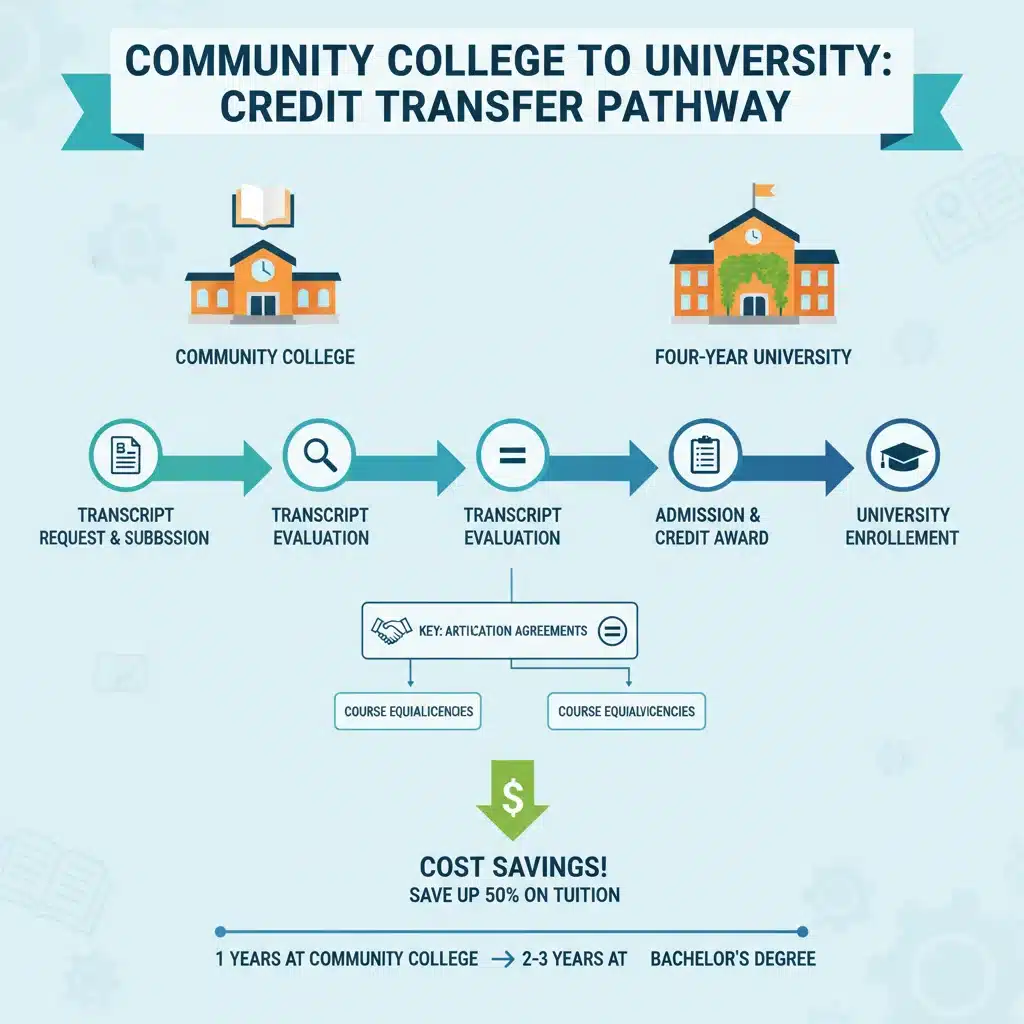
The most straightforward path for transferring credits is through articulation agreements. These are formal, written agreements between community colleges and universities that specify which community college courses will be accepted for credit at the university and how they will apply towards a specific major or general education requirements. Many states have statewide articulation agreements, often referred to as "2+2 programs," which guarantee that if you complete an Associate of Arts (AA) or Associate of Science (AS) degree at a community college, you can seamlessly transfer as a junior to a state university.
Key steps:
- Research early: As soon as you consider attending community college, identify the universities you might want to transfer to.
- Check specific program agreements: Don’t just look for general transfer agreements. Investigate if there are specific articulation agreements for your intended major. This ensures that your community college courses align directly with your university major requirements.
- Consult with advisors: Work closely with academic advisors at both your community college and the target university. They can help you plan your coursework to maximize transferable credits and avoid taking unnecessary courses.
Course Equivalency and General Education Requirements
Even without a formal articulation agreement, individual courses can often be transferred based on course equivalency. Universities will evaluate your community college transcripts to determine if the content and rigor of a course meet their standards for a similar university course.
General education requirements (often called "gen eds" or "core curriculum") are typically the easiest community college credits to transfer. These foundational courses (e.g., English composition, introductory math, basic sciences, humanities) are often standardized across institutions.
Tips for success:
- Keep course syllabi: Maintain detailed syllabi for all your community college courses. If there’s a question about course equivalency, the syllabus provides crucial information to the university’s evaluation committee.
- Aim for high grades: While credits may transfer, universities often have minimum GPA requirements for transfer students. A strong academic record at community college enhances your transfer application.
- Understand residency requirements: Many universities require students to complete a certain number of credits directly at their institution (residency requirements) to earn a degree. Be aware of these limitations.
Strategic Planning for Seamless Transfer in 2026
To truly leverage community college credits for maximum savings and a smooth transition, a strategic approach is essential. This isn’t just about taking classes; it’s about building a coherent academic plan from day one.
Step-by-Step Transfer Strategy:
- Identify Target Universities and Majors: Before enrolling in community college, have a clear idea of where you want to end up and what you want to study. This informs your community college course selection.
- Meet with University Admissions/Transfer Counselors: Engage with university representatives early. They can provide invaluable insights into their specific transfer policies, preferred community colleges, and any unique program requirements.
- Create a Detailed Course Plan: Work with both community college and university advisors to map out every course you’ll take at community college, ensuring each one fulfills a university requirement. This is where articulation agreements are gold.
- Understand Application Deadlines and Requirements: Transfer application processes can differ from first-year applications. Be aware of specific deadlines, required essays, recommendation letters, and transcript submission procedures.
- Maintain Academic Excellence: A strong GPA at community college not only helps with credit transfer but also makes you a more competitive applicant for scholarships at your target university.
- Get Involved: Participate in extracurricular activities, volunteer work, or student government at your community college. This strengthens your transfer application and helps you develop valuable skills.
Common Pitfalls to Avoid:
- Taking too many non-transferable credits: Every credit you take that doesn’t transfer is a waste of time and money.
- Not verifying transferability: Never assume a course will transfer. Always verify with the target university.
- Missing application deadlines: Late applications can delay your university enrollment.
- Not meeting GPA requirements: Some universities have higher GPA requirements for transfer students than for incoming freshmen.
- Ignoring general education requirements: Ensure your community college courses cover your university’s gen-ed curriculum.
By meticulously planning and actively engaging with academic resources, you can ensure your community college credits pave a clear and affordable path to your university degree.
Beyond Tuition: Financial Aid and Scholarship Opportunities for Transfer Students
While leveraging community college credits directly reduces tuition costs, it’s important to remember that financial aid and scholarships remain crucial components of funding your university education. Transfer students are eligible for many of the same financial aid opportunities as traditional four-year students, but there are also specific considerations.
Federal and State Financial Aid:
- FAFSA (Free Application for Federal Student Aid): This is the gateway to federal grants, loans, and work-study programs. You must complete the FAFSA every year you plan to attend college, including your community college years and your university years. Your Expected Family Contribution (EFC) will determine your eligibility.
- State Grants: Many states offer their own grant programs based on financial need or academic merit. Research your state’s higher education agency for specific opportunities.
- Federal Student Loans: While grants are preferable as they don’t need to be repaid, federal student loans offer lower interest rates and more flexible repayment options compared to private loans.
Scholarships for Transfer Students:
Don’t overlook scholarships! Many universities and external organizations offer scholarships specifically for transfer students, recognizing their unique journey and academic achievements at community college.
- University-Specific Scholarships: As you research target universities, inquire about scholarships designated for transfer students. These might be based on academic merit (GPA from community college), leadership, specific majors, or financial need.
- Community College Foundation Scholarships: Your community college itself may offer scholarships for students transferring to a four-year institution.
- External Scholarships: Websites like Fastweb, Scholarship.com, and the College Board’s scholarship search tool can help you find scholarships from private organizations. Filter your search for "transfer student" or "community college graduate."
- Phi Theta Kappa (PTK) Scholarships: If you excel academically at community college, consider joining Phi Theta Kappa, the international honor society for two-year colleges. PTK members are often eligible for exclusive transfer scholarships from partner universities, significantly boosting your chances of securing financial aid.
Pro-Tip for 2026: Start your scholarship search early, even while at community college. Many deadlines are well in advance of the academic year. Craft compelling essays that highlight your unique transfer journey, your resilience, and your academic goals.

The Broader Benefits of Starting with Community College Credits
While the financial savings are a primary driver, the advantages of beginning your higher education with community college credits extend far beyond the balance sheet. This pathway offers a unique set of benefits that can contribute to a more successful and fulfilling academic experience.
Academic and Personal Growth:
- Smoother Transition: For many students, the transition from high school to a large university can be overwhelming. Community colleges often provide a more supportive and nurturing environment with smaller class sizes and more accessible faculty, easing the adjustment to college-level academics.
- Exploring Interests: Community college can be an excellent place to explore different academic fields without the high financial commitment of a university. If you’re undecided about your major, you can take introductory courses in various subjects to find your passion before committing to a specific university program.
- Building a Strong Academic Foundation: The foundational courses at community colleges are often taught by experienced professors dedicated to teaching, rather than research. This can help you build a solid academic base, improving your chances of success once you transfer to a university.
- Developing Study Habits: The structured environment of community college can help students develop effective study habits, time management skills, and self-discipline, all crucial for thriving in a university setting.
Flexibility and Accessibility:
- Local and Commuter Friendly: Community colleges are typically located within commuting distance for most students, allowing them to save on housing costs and maintain connections with their local community and family.
- Diverse Student Body: Community colleges attract a wide range of students – recent high school graduates, working adults, veterans, and individuals seeking career changes. This diverse environment can enrich your learning experience and broaden your perspective.
- Part-Time and Evening Options: The flexibility of course schedules at community colleges makes it easier for students to balance their studies with work, family responsibilities, or other commitments. This accessibility ensures that higher education remains within reach for more individuals.
Enhanced University Experience:
Students who transfer with community college credits often arrive at university more mature, focused, and academically prepared. They have already navigated the college system, developed study skills, and often have a clearer sense of their academic and career goals. This can lead to a more productive and successful university experience, allowing them to dive directly into their major coursework and make the most of university resources.
The Future of Transfer: Trends and Predictions for 2026 and Beyond
The role of community college credits in higher education is not static; it’s an evolving landscape. As we look towards 2026 and beyond, several trends are likely to strengthen the value proposition of this pathway.
Increased Emphasis on "Stackable Credentials":
The concept of stackable credentials – where certificates and associate degrees can build upon each other towards a bachelor’s degree – is gaining traction. This modular approach allows students to earn valuable credentials along the way, improving employability even if they pause their education, while still providing a clear path to a four-year degree using their community college credits.
More Robust Articulation Agreements and Pathways:
As universities recognize the value and quality of community college education, expect to see even more comprehensive and streamlined articulation agreements. States and institutions are continually working to reduce transfer friction, making the process more predictable and transparent for students. This will include clearer course equivalencies and expanded 2+2 programs.
Growth in Online and Hybrid Offerings:
The pandemic significantly accelerated the adoption of online learning. Community colleges, known for their flexibility, are at the forefront of this trend. Students will have even more options to complete their initial community college credits through online or hybrid formats, offering unparalleled flexibility and accessibility, especially for non-traditional students.
Employer Recognition of Associate Degrees:
While the focus here is on transferring to a university, it’s worth noting that associate degrees themselves are gaining greater recognition in the job market. This provides a valuable safety net and immediate employment opportunities for students who might choose to enter the workforce after community college, or who need to work while completing their bachelor’s degree.
Focus on Career-Aligned Pathways:
Community colleges are increasingly partnering with local industries to offer programs that directly address workforce needs. These career-aligned programs, often leading to an associate degree, are designed with transferability in mind, ensuring that the community college credits earned are relevant and valuable for a subsequent university degree in a related field.
These trends suggest that leveraging community college credits will not only remain a financially savvy choice but will also become an increasingly integrated, efficient, and recognized pathway to a bachelor’s degree in the coming years. Students who embrace this strategy will be well-positioned to navigate the evolving educational landscape successfully.
Conclusion: Your Path to Affordable University Education Starts Now
The dream of a university education doesn’t have to be synonymous with overwhelming debt. By strategically harnessing the power of community college credits, you can unlock significant savings, gain a strong academic foundation, and enjoy a smoother transition into your desired four-year institution. The potential to save 30% or more on university tuition in 2026 is not just a pipe dream; it’s a tangible reality for those who plan wisely.
From understanding articulation agreements and meticulously planning your coursework to diligently applying for financial aid and scholarships, every step in this journey is an investment in your future. Community colleges offer an accessible, high-quality, and cost-effective entry point into higher education, providing a pathway that is both academically enriching and financially responsible.
Don’t let the rising cost of university tuition deter you from pursuing your academic aspirations. Embrace the smart strategy of starting with community college credits. Begin your research today, connect with advisors, and chart a course that leads to both a valuable degree and a healthier financial future. Your journey to an affordable university education in 2026 starts with informed decisions and proactive planning.