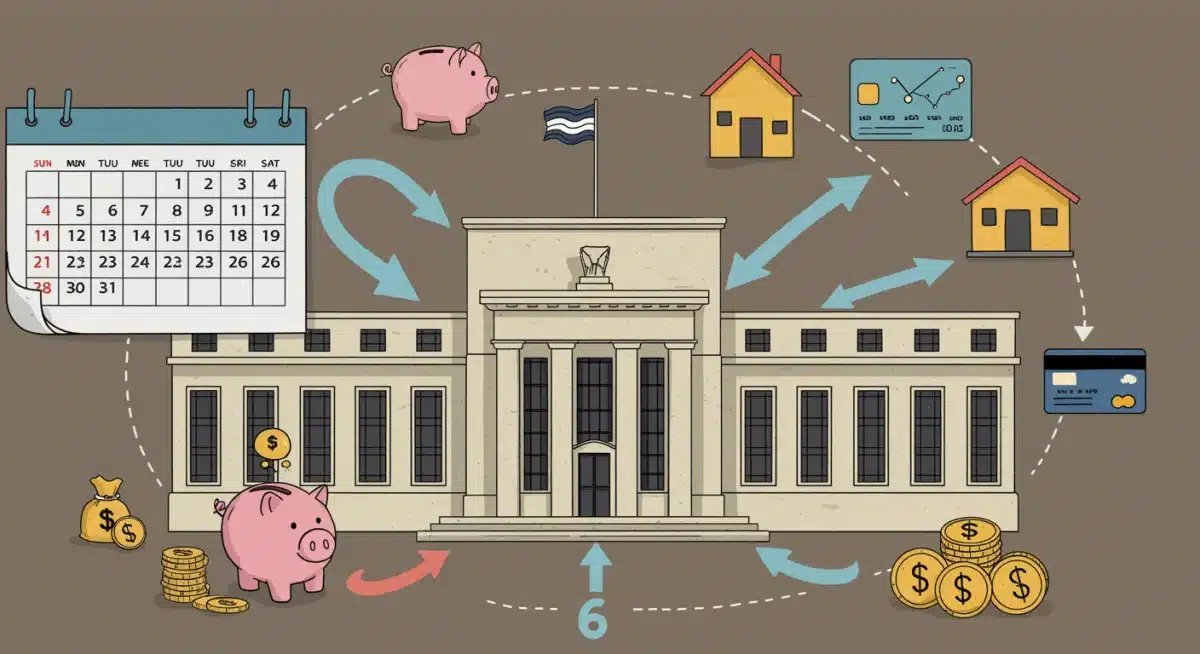
Understanding the intricate dance between the Federal Reserve’s monetary policies and your personal bank account is more crucial than ever. As we look ahead to 2026, the decisions made by the Fed will continue to ripple through every facet of the economy, directly influencing your savings, investments, debt, and even your job security. This comprehensive guide will delve into the anticipated impact of Fed Policies 2026 over the next six months, providing you with a clear projection and actionable strategies to navigate the evolving financial landscape.
The Federal Reserve, often referred to as ‘the Fed,’ is the central banking system of the United States. Its primary mandates are to maximize employment, stabilize prices (control inflation), and moderate long-term interest rates. To achieve these goals, the Fed employs various tools, including adjusting the federal funds rate, engaging in quantitative easing or tightening, and setting reserve requirements for banks. Each of these actions has a direct or indirect effect on your financial well-being.
As we step into 2026, the economic environment is expected to be a complex mix of lingering effects from past policies and new challenges. Geopolitical events, technological advancements, and evolving consumer behaviors will all play a role, but the Fed’s response to these factors will be a dominant force shaping the financial future. This article aims to demystify these complex interactions, offering you a roadmap to make informed financial decisions.
Understanding the Federal Reserve’s Mandate and Tools
Before we project the impact of Fed Policies 2026, it’s essential to grasp the core functions and instruments at the Fed’s disposal. The dual mandate of maximum employment and price stability guides all its decisions. When unemployment is high, the Fed might pursue expansionary policies to stimulate growth. Conversely, when inflation is soaring, contractionary policies are often implemented to cool down the economy.
The primary tool is the federal funds rate, which is the target interest rate that banks charge each other for overnight borrowing. While you don’t directly pay this rate, it influences all other interest rates in the economy, from mortgages and car loans to savings accounts and credit cards. A higher federal funds rate generally leads to higher borrowing costs for consumers and businesses, and potentially higher returns on savings. A lower rate has the opposite effect.
Another significant tool is quantitative easing (QE) or quantitative tightening (QT). QE involves the Fed buying government securities and other assets to inject money into the financial system, lowering long-term interest rates and encouraging lending. QT, on the other hand, involves the Fed reducing its balance sheet by selling off assets or allowing them to mature without reinvestment, which tends to push long-term interest rates higher. These actions have profound implications for bond markets, equity valuations, and the overall availability of credit.
The Fed also sets reserve requirements, which dictate the percentage of deposits banks must hold in reserve. While less frequently adjusted, changes here can impact the amount of money banks have available to lend. Furthermore, the Fed communicates its outlook and intentions through speeches, meeting minutes, and economic projections. These communications, known as ‘forward guidance,’ can significantly influence market expectations and investor behavior even before any concrete policy actions are taken.
For 2026, the Fed’s focus will likely remain on achieving its dual mandate amidst a dynamic global economic landscape. The balance between managing inflation and supporting economic growth will be delicate, and policy adjustments will be highly data-dependent. Understanding these foundational elements is the first step in preparing your personal finances for the coming changes driven by Fed Policies 2026.
The Economic Outlook for Early 2026: A Foundation for Policy
To accurately project the impact of Fed Policies 2026, we must first consider the likely economic environment. While no one has a crystal ball, economic forecasts suggest a continued focus on balancing inflation control with maintaining a healthy labor market. Many economists anticipate that by early 2026, inflation, while potentially moderated from peak levels, could still be a concern, perhaps hovering above the Fed’s long-term target of 2%. This persistent inflationary pressure could stem from ongoing supply chain issues, geopolitical tensions, or strong consumer demand.
The labor market is expected to remain relatively robust, though perhaps cooling slightly from the tight conditions seen in previous years. Unemployment rates might tick up marginally as the economy adjusts, but a significant surge in job losses is generally not expected unless a severe recession materializes. Wage growth, a key component of inflation, will be closely watched. If wage growth remains elevated, it could fuel further inflationary pressures, prompting a more hawkish stance from the Fed.
Global economic conditions will also play a crucial role. Slowdowns in major economies, or conversely, unexpected booms, can impact demand for U.S. goods and services, affecting corporate earnings and the overall economic picture. The strength of the U.S. dollar, influenced by interest rate differentials, will also have implications for trade and the cost of imports and exports.
Against this backdrop, the Fed’s stance in the first half of 2026 is likely to be characterized by prudence and data dependency. They will be carefully assessing incoming economic data – inflation reports, employment figures, consumer spending, and business investment – before making any significant policy shifts. This cautious approach means that while major rate hikes might be less likely than in previous periods, the possibility of maintaining higher rates for longer, or even modest increases if inflation proves stubborn, cannot be ruled out. This economic baseline sets the stage for understanding the specific impacts of Fed Policies 2026 on your finances.
Projected Impact of Fed Policies 2026 on Interest Rates (Months 1-3)
The first three months of 2026 will likely see the Federal Reserve continuing to monitor economic data closely, with potential implications for interest rates. If inflation remains elevated but shows signs of gradual deceleration, the Fed might opt to maintain the federal funds rate at its current level, or perhaps implement a modest hike if inflationary pressures prove more stubborn than anticipated. This ‘higher for longer’ scenario for interest rates has several direct consequences for your personal finances.
Mortgages and Housing Market
Higher interest rates translate directly into higher mortgage rates. If the Fed maintains or slightly increases rates, new homebuyers will face elevated borrowing costs, impacting affordability and potentially dampening demand. For those with adjustable-rate mortgages (ARMs), monthly payments could increase, adding strain to household budgets. The housing market, already sensitive to interest rate fluctuations, might experience a continued slowdown in sales volume, though home prices could remain resilient in desirable areas due to limited supply.
Savings Accounts and CDs
On the flip side, higher interest rates are generally good news for savers. Banks tend to offer more attractive interest rates on savings accounts, money market accounts, and Certificates of Deposit (CDs) when the federal funds rate is high. This provides an opportunity for individuals to earn more on their cash holdings, making it a good time to review your savings strategy and potentially lock in higher rates with CDs for a portion of your emergency fund or short-term savings goals.
Credit Cards and Personal Loans
Consumers carrying balances on credit cards and personal loans will likely continue to face higher interest payments. These types of debt often have variable interest rates tied to the prime rate, which moves in tandem with the federal funds rate. It becomes even more critical to prioritize paying down high-interest debt during periods of elevated rates to minimize the financial burden. Consolidating debt into a lower-interest loan, if available, could be a wise strategy.
Auto Loans
New auto loans will also reflect the higher interest rate environment. This means higher monthly payments for car buyers, making it essential to shop around for the best rates and consider the total cost of ownership. Used car prices might see increased demand as consumers seek more affordable options, though financing for used cars will also be more expensive.
During this initial three-month period, the Fed’s communication will be key. Any hints about future rate decisions or the trajectory of inflation will be closely scrutinized by markets and will directly influence the rates you encounter as a consumer. Staying informed about these pronouncements is crucial for anticipating the next moves in Fed Policies 2026.
Projected Impact of Fed Policies 2026 on Investments (Months 1-3)
The initial months of 2026 will present a nuanced environment for investors, largely shaped by the Fed’s interest rate stance and its ongoing battle against inflation. As the Fed Policies 2026 unfold, investors will need to be agile and strategic.
Stock Market Volatility
If interest rates remain elevated or see a modest increase, the stock market could experience continued volatility. Higher interest rates make borrowing more expensive for companies, potentially impacting their profitability and growth prospects. Furthermore, higher rates offer an alternative for investors in the form of safer, interest-bearing assets like bonds, which can draw money away from equities. Growth stocks, in particular, which rely heavily on future earnings projections, can be more sensitive to rising rates as their future cash flows are discounted more heavily.
Bond Market Opportunities
A ‘higher for longer’ interest rate environment generally creates attractive opportunities in the bond market. New bonds issued will offer higher yields, making them more appealing to income-focused investors. Existing bonds, however, might see their prices fall as new, higher-yielding bonds become available. Investors looking for stability and income might consider investing in short-to-intermediate term bonds or bond funds, which are less sensitive to interest rate fluctuations than long-term bonds.
Real Estate Investment Trusts (REITs)
REITs, which are companies that own, operate, or finance income-producing real estate, can be affected by interest rate changes. Higher borrowing costs for REITs can impact their profitability and dividend payouts. Additionally, if higher mortgage rates cool the housing market, certain types of REITs (e.g., residential REITs) could face headwinds. However, some REIT sectors, like those focused on data centers or industrial properties, might be more resilient depending on underlying demand.
Alternative Investments
In a higher interest rate environment, alternative investments like commodities (gold, silver, oil) might react differently. Gold, often seen as a hedge against inflation and economic uncertainty, could perform well, especially if real interest rates (nominal rates minus inflation) remain low or negative. However, a strong dollar, often a consequence of higher U.S. rates, can make dollar-denominated commodities more expensive for international buyers, potentially dampening demand.
Investors should review their portfolios, assess their risk tolerance, and consider diversifying across different asset classes. It’s a time for careful due diligence and potentially rebalancing to align with the evolving economic conditions shaped by Fed Policies 2026. Consulting a financial advisor to tailor strategies to your specific goals is highly recommended.
Mid-2026 Projections: Shifting Sands of Fed Policy (Months 4-6)
As we move into the middle of 2026, the trajectory of Fed Policies 2026 will become clearer, heavily influenced by the economic data gathered in the preceding months. The Fed’s actions during this period could signify a pivot, a continuation of the current stance, or even a more aggressive approach, depending on the inflation and employment figures.
Potential for Rate Cuts or Sustained High Rates
If inflation shows sustained signs of returning to the Fed’s 2% target, coupled with a mild softening in the labor market, there might be increased discussion and even a possibility of modest interest rate cuts towards the latter half of 2026. Such cuts would aim to prevent an unnecessary economic slowdown. Conversely, if inflation proves persistent and the labor market remains excessively tight, the Fed could maintain its ‘higher for longer’ stance well into the year, or even consider further, albeit smaller, rate hikes.
Impact on Consumer Spending and Economic Growth
Any shift in interest rate policy will have a profound impact on consumer spending, which is a major driver of economic growth. If rates begin to fall, borrowing becomes cheaper, potentially stimulating demand for big-ticket items like cars and homes. This could lead to an uptick in economic activity. If rates remain high, however, consumers might continue to be cautious with their discretionary spending, potentially leading to slower economic growth.
Inflationary Pressures and Wage Growth
The Fed’s decisions in mid-2026 will largely hinge on the inflation outlook. If supply chain issues resolve, energy prices stabilize, and wage growth moderates, the Fed will have more room to consider easing its policies. However, unexpected shocks – such as new geopolitical conflicts or commodity price spikes – could reignite inflationary pressures, forcing the Fed to maintain a restrictive stance.
The mid-2026 period will be critical for understanding the long-term direction of Fed Policies 2026. Investors and consumers alike should pay close attention to the Fed’s official statements, economic projections, and the rhetoric from key Fed officials. These insights will be invaluable for adjusting personal financial strategies and preparing for the economic environment ahead.
Personal Finance Strategies for the Next 6 Months
Given the projected impact of Fed Policies 2026, proactive financial planning is essential. Here are actionable strategies to help you navigate the next six months and beyond:
1. Optimize Your Savings
With potentially higher interest rates on savings accounts and CDs, make sure your cash isn’t sitting idle in a low-yield account. Shop around for high-yield savings accounts or consider Certificate of Deposit (CD) ladders to lock in better rates while maintaining liquidity. An emergency fund covering 3-6 months of essential expenses remains paramount, regardless of the interest rate environment.
2. Tackle High-Interest Debt
If you have outstanding credit card balances or personal loans with variable interest rates, prioritize paying them down aggressively. The longer rates remain elevated, the more you’ll pay in interest. Consider debt consolidation options if you can secure a lower fixed rate, but be wary of fees and ensure the new terms are truly beneficial.
3. Review Your Investment Portfolio
This is a crucial time for portfolio review. Diversification across various asset classes (stocks, bonds, real estate, commodities) can help mitigate risk. Consider if your current asset allocation aligns with your risk tolerance and time horizon, especially in a potentially volatile market. For investors nearing retirement, a more conservative approach might be warranted, emphasizing income-generating assets like high-quality bonds or dividend stocks.
For younger investors with a longer time horizon, market downturns can present buying opportunities, but a disciplined approach using dollar-cost averaging is often advisable.
4. Assess Your Housing Situation
If you’re considering buying a home, be mindful of mortgage rates. While they might cool the market, making more inventory available, the cost of borrowing will be higher. If you have an adjustable-rate mortgage (ARM), understand when your rate might reset and what the potential payment increase could be. Exploring refinancing options to a fixed-rate mortgage might be prudent if rates show signs of stabilizing or decreasing, but always compare the new rate with your current one and account for closing costs.
5. Budget for Inflation
Even if inflation moderates, the cost of living may remain elevated. Review your household budget to identify areas where you can cut back or optimize spending. Factor in higher costs for necessities like groceries, utilities, and transportation. Building a buffer into your budget can help absorb unexpected price increases.
6. Enhance Your Skills and Career Prospects
In an uncertain economic climate, job security is vital. Invest in your professional development by acquiring new skills, pursuing certifications, or networking within your industry. A strong professional standing provides a greater sense of financial security, regardless of the broader economic trends influenced by Fed Policies 2026.
7. Stay Informed and Adaptable
The economic landscape is constantly evolving. Regularly follow financial news, especially announcements from the Federal Reserve. Being informed allows you to anticipate changes and adapt your financial strategies accordingly. Flexibility and a willingness to adjust your plans will be your greatest assets.
Longer-Term Implications Beyond 6 Months
While our focus has been on the immediate six-month projection, it’s important to understand that Fed Policies 2026 will have ramifications that extend far beyond that timeframe. The decisions made by the Federal Reserve in the first half of the year will set the stage for the economic environment for the remainder of 2026 and potentially into 2027.
Inflationary Trends
The success (or lack thereof) in bringing inflation down to the Fed’s target will dictate future policy. If inflation proves sticky, the Fed might be forced to maintain a restrictive stance for longer, potentially leading to a more prolonged period of higher interest rates. Conversely, if inflation is successfully tamed, the Fed could begin a more sustained easing cycle, which would have significant positive impacts on borrowing costs and investment.
Economic Growth Trajectory
The Fed’s actions will influence the overall pace of economic growth. A prolonged period of high interest rates could slow down investment and consumer spending, potentially leading to a mild recession or a period of sluggish growth. A more accommodative Fed, on the other hand, could spur economic expansion. The balance between these two outcomes is delicate, and the Fed’s decisions will be crucial in determining the path.

Labor Market Dynamics
The health of the labor market is a key indicator for the Fed. If unemployment rises significantly, the Fed might shift towards more accommodative policies to support job growth. However, if wage growth continues to fuel inflation, the Fed might prioritize price stability, even if it means some softening in the job market. The interplay between these two mandates will shape the employment landscape.
Global Economic Interdependencies
U.S. monetary policy doesn’t operate in a vacuum. The Fed’s decisions have global implications, affecting exchange rates, capital flows, and the economic policies of other countries. A strong dollar due to higher U.S. rates can make U.S. exports more expensive, potentially impacting global trade. Conversely, a weaker dollar could boost exports but might also contribute to imported inflation. These global dynamics will continue to influence the Fed’s considerations.
For your personal finances, a long-term perspective means continuous adaptation. The strategies you implement in the next six months should be flexible enough to adjust to these evolving longer-term trends. Regularly re-evaluating your financial goals, investment risk, and debt management strategies will be key to thriving in the changing economic climate shaped by Fed Policies 2026 and beyond.
Conclusion: Navigating the Financial Waters of 2026
The impact of Fed Policies 2026 on your personal finances is undeniable and multifaceted. From the interest rates on your mortgage and savings to the performance of your investment portfolio, the Federal Reserve’s decisions will continue to be a dominant force shaping your financial landscape over the next six months and into the foreseeable future. Understanding the Fed’s mandate, its tools, and the prevailing economic conditions is the first step towards proactive financial management.
The initial months of 2026 are likely to be characterized by a cautious Fed, potentially maintaining higher interest rates to combat persistent inflation. This scenario presents both challenges, such as increased borrowing costs, and opportunities, like higher returns on savings. As the year progresses, the Fed’s stance could shift, depending on how inflation and employment figures evolve, potentially leading to adjustments in interest rates that further influence the economy.
By implementing sound personal finance strategies – optimizing savings, aggressively tackling high-interest debt, reviewing investment portfolios, carefully assessing housing decisions, budgeting for inflation, and continuously enhancing your career prospects – you can position yourself to not only withstand potential economic headwinds but also capitalize on emerging opportunities. Staying informed and maintaining flexibility in your financial plans will be your greatest assets in navigating the dynamic economic environment.
Remember, while the Fed’s influence is significant, your personal financial discipline and strategic planning are ultimately what will determine your financial success. By staying ahead of the curve and adapting to the evolving landscape shaped by Fed Policies 2026, you can build a resilient financial future.