Disability Benefits 2026: SSDI vs. SSI Comparison

Understanding the nuances of disability benefits in 2026 is crucial for those seeking financial assistance; this guide clarifies the differences between SSDI and SSI to help individuals make informed decisions about their support options.
Navigating the complex landscape of disability benefits 2026 can be daunting, especially when trying to determine which program, Social Security Disability Insurance (SSDI) or Supplemental Security Income (SSI), is best suited for your individual needs. This article aims to demystify these critical support systems, providing a clear comparison to help you understand your options and secure the assistance you deserve.
Understanding Social Security Disability Insurance (SSDI)
Social Security Disability Insurance (SSDI) is a federal insurance program funded by payroll taxes. It provides benefits to individuals who have worked long enough and recently enough, paying Social Security taxes on their earnings, and who have a medical condition that meets the Social Security Administration’s (SSA) definition of disability. Essentially, it’s an earned benefit, much like retirement benefits, but triggered by disability rather than age.
Eligibility for SSDI is primarily based on work credits, which are earned through employment where Social Security taxes are paid. The number of work credits required depends on your age when your disability began. For most adults, this means having accumulated a certain number of credits over a specified period, typically 20 credits in the last 10 years ending with the year you became disabled. These credits demonstrate a consistent work history and contribution to the Social Security system.
Work Credits and Eligibility for SSDI
Work credits are the cornerstone of SSDI eligibility. The SSA assigns one work credit for a certain amount of earnings, and you can earn up to four credits per year. The exact dollar amount needed to earn a credit changes annually. For example, in 2026, the amount might slightly increase from previous years, reflecting economic adjustments. Understanding your work credit history is a crucial first step in assessing your potential for SSDI.
- Age at Disability Onset: The younger you are when you become disabled, the fewer work credits you generally need.
- Recent Work History: A significant portion of your required work credits must have been earned recently, typically within the last decade before your disability began.
- Earnings Threshold: You must have earned enough income to accumulate the necessary work credits over your working life.
The Application Process for SSDI
Applying for SSDI involves a detailed process that can often be lengthy. It typically starts with an online application or by contacting the SSA directly. You’ll need to provide extensive medical documentation, including diagnoses, treatment records, and statements from your healthcare providers. The SSA uses this information to determine if your condition meets their strict definition of disability, which means you cannot engage in substantial gainful activity (SGA) due to your medical condition, and it is expected to last for at least one year or result in death.
The initial application is reviewed by a state agency, Disability Determination Services (DDS), which makes the medical decision. If denied, you have the right to appeal, moving through several stages: reconsideration, a hearing before an Administrative Law Judge (ALJ), and potentially further appeals to the Appeals Council and federal court. Persistence and thorough documentation are key throughout this process.
Exploring Supplemental Security Income (SSI)
Supplemental Security Income (SSI) is a needs-based program that provides financial assistance to aged, blind, or disabled individuals who have limited income and resources. Unlike SSDI, SSI is not funded by Social Security taxes and does not require a work history. It’s designed to provide a minimum level of income for those who otherwise wouldn’t have sufficient financial support.
The eligibility requirements for SSI are centered around financial need. The SSA looks at your income, including earned income, unearned income, and in-kind support, as well as your countable resources, such as bank accounts, cash, and certain assets. There are strict limits on both income and resources. For example, in 2026, the resource limit for an individual will likely remain around $2,000, and for a couple, around $3,000, though these figures are subject to annual adjustments.
Income and Resource Limits for SSI
Understanding the income and resource limits is paramount for SSI eligibility. Not all income counts towards the limit; the SSA excludes certain types of income, such as the first $20 of most unearned income and the first $65 of earned income plus half of the amount over $65. This allows individuals to have some income while still qualifying for benefits. Resources, however, are generally more straightforward, with most liquid assets being counted.
- Countable Income: The SSA has specific rules for what income is counted and what is excluded when determining eligibility.
- Resource Limits: Strict limits apply to assets like cash, bank accounts, stocks, and other easily convertible items.
- Living Arrangements: Your living situation can also affect your SSI benefit amount, as in-kind support and maintenance can be considered income.
The SSI Application Journey
The application for SSI also begins with the SSA, either online or in person. Similar to SSDI, you will need to provide medical evidence of your disability. However, a significant portion of the SSI application focuses on your financial situation. You’ll be asked to provide detailed information about your income, resources, and living expenses. The SSA will verify this information through various means, including bank statements and property records.
The medical determination for SSI is the same as for SSDI, handled by the state’s DDS. If your application is denied, the appeals process is identical to that of SSDI, offering multiple layers of review. Because of the financial scrutiny, it’s essential to be completely transparent and accurate in reporting your financial status to avoid delays or issues.
Key Differences Between SSDI and SSI in 2026
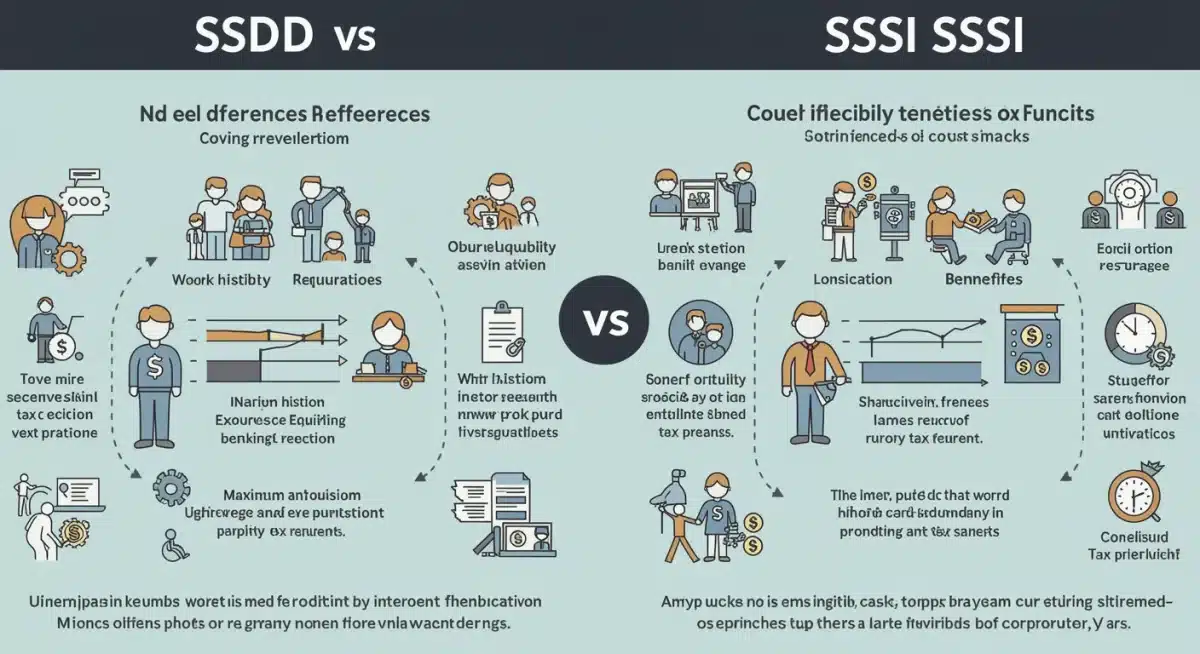
While both SSDI and SSI provide crucial support to individuals with disabilities, their fundamental structures and eligibility criteria differ significantly. These distinctions are vital for anyone seeking disability benefits 2026 to understand which program aligns with their personal and financial circumstances. The source of funding, work history requirements, and financial need assessments are the primary differentiating factors.
SSDI is an earned benefit, meaning you must have worked and paid Social Security taxes. It’s essentially an insurance policy you’ve paid into. SSI, conversely, is a needs-based program, providing a safety net for those with limited income and resources, regardless of their work history. This means that even if you’ve never worked, you could still be eligible for SSI if you meet the financial and medical criteria.
Funding and Eligibility Criteria
The funding mechanisms for SSDI and SSI are distinct. SSDI benefits are paid from the Social Security trust funds, which are financed by FICA taxes. This makes SSDI an entitlement program for those who have contributed. SSI, on the other hand, is funded by general tax revenues, not Social Security taxes, underscoring its role as a welfare program for those in financial need.
- SSDI: Requires a qualifying work history and payment of Social Security taxes.
- SSI: Does not require a work history but has strict income and resource limits.
- Medical Definition of Disability: Both programs use the same medical criteria to define disability.
Benefit Amounts and Healthcare Coverage
The benefit amounts also vary significantly. SSDI benefits are based on your average lifetime earnings, meaning higher earners generally receive higher monthly benefits, up to a maximum amount. SSI benefits, however, are a standardized federal amount, which can be supplemented by state payments in some regions. The federal benefit rate (FBR) for SSI is adjusted annually for cost-of-living increases, providing a consistent baseline for recipients.
Healthcare coverage is another critical difference. SSDI recipients generally become eligible for Medicare after a 24-month waiting period from their entitlement to disability benefits. SSI recipients, in most states, are automatically eligible for Medicaid, which provides immediate and comprehensive health coverage. This immediate access to healthcare can be a deciding factor for many applicants.
Navigating the Application Process for Disability Benefits in 2026
The application process for both SSDI and SSI can be complex and intimidating, requiring meticulous attention to detail and a thorough understanding of the requirements. As we look towards 2026, while the core regulations are expected to remain stable, there may be minor adjustments to income thresholds or procedural guidance. Successfully navigating this process often depends on preparation and accurate submission of all required documentation.
It’s crucial to gather all relevant medical records, including doctor’s notes, hospitalizations, lab results, and imaging scans. These documents serve as the primary evidence of your disability. Additionally, be prepared to provide detailed information about your work history, educational background, and daily activities, as these help the SSA understand the impact of your condition on your ability to work and live independently.
Essential Documentation and Evidence
The strength of your application hinges on the quality and completeness of your documentation. Medical evidence is paramount, but supplemental information can also be incredibly valuable. Statements from former employers, vocational rehabilitation counselors, or even family members can paint a clearer picture of your limitations and how they affect your capacity for work. The more comprehensive your submission, the better your chances of a favorable decision.
- Medical Records: Include all diagnostic tests, treatment plans, and prognoses.
- Work History: Provide dates, job duties, and reasons for leaving previous employment.
- Personal Statements: Detail how your disability affects your daily life and ability to perform work-related tasks.
Tips for a Successful Application
To maximize your chances of approval, consider several key strategies. Firstly, be honest and thorough in your application; any inconsistencies can lead to delays or denials. Secondly, continue to seek medical treatment for your condition, as ongoing treatment demonstrates the severity and persistence of your disability. Lastly, don’t hesitate to seek professional assistance. Disability advocates or attorneys specialize in these cases and can significantly improve your application’s strength and navigate the appeals process if necessary.
Remember that the SSA’s definition of disability is very specific. Your condition must prevent you from engaging in substantial gainful activity (SGA) and be expected to last at least 12 months or result in death. Simply having a medical condition is not enough; it must severely limit your ability to work. Focusing on how your condition meets these criteria throughout your application is vital.
Which Program Offers Better Support for Your Needs?
Deciding between SSDI and SSI, or understanding if you qualify for both, depends entirely on your unique circumstances. There isn’t a universally ‘better’ program; rather, there’s the program that best fits your work history, financial situation, and medical needs. Many individuals actually qualify for both programs simultaneously, a situation often referred to as ‘concurrent benefits’, where SSI can supplement a low SSDI payment.
If you have a substantial work history and have paid into the Social Security system, SSDI is likely your primary avenue for support. The benefits are often higher, and it leads to Medicare eligibility. However, if your work history is limited, or your income and resources are very low, SSI is designed to provide that essential financial safety net, often with immediate Medicaid access.
Assessing Your Work History and Financial Situation
The first step in determining which program is right for you is to honestly assess your work history. Do you have enough work credits? You can check your Social Security statement online to see your earnings record and estimated benefits. Simultaneously, evaluate your current income and resources. Are they below the strict limits set for SSI? A clear understanding of these two aspects will guide you significantly.
- Strong Work History: Leans towards SSDI eligibility.
- Limited Work History/Low Income: Points towards SSI eligibility.
- Both Conditions Met: You may qualify for concurrent benefits, maximizing your overall support.
Considering Healthcare and Long-Term Planning
Beyond immediate financial assistance, consider the long-term implications for healthcare. Medicare for SSDI recipients typically starts after a 24-month waiting period, which can be a significant gap. Medicaid for SSI recipients is usually effective immediately. This difference can be critical for those with ongoing medical needs. Furthermore, understand that working while receiving benefits has different rules for each program, impacting your ability to gradually return to employment without losing benefits.
Consulting with an expert, such as a benefits specialist or a legal professional specializing in disability law, can provide personalized guidance. They can help you understand the intricacies of each program, assist with the application, and represent you during appeals. Their expertise can be invaluable in securing the disability benefits 2026 you need to maintain your quality of life.
Common Misconceptions About Disability Benefits
Many individuals hold common misconceptions about disability benefits, which can sometimes deter them from applying or lead to misunderstandings during the process. One prevalent myth is that it’s nearly impossible to get approved for disability benefits. While the process is rigorous and denial rates are high at the initial stages, many legitimate claims are eventually approved, especially with proper documentation and legal representation.
Another common misunderstanding is that receiving disability benefits means you can never work again. This isn’t entirely true. Both SSDI and SSI have work incentive programs, like the Ticket to Work program for SSDI, which allow beneficiaries to test their ability to work without immediately losing their benefits. These programs are designed to encourage self-sufficiency while providing a safety net.
Addressing Eligibility Myths
Some people believe that if they have a severe medical condition, they will automatically be approved. While a severe condition is necessary, it must meet the SSA’s specific definition of disability, which focuses on your inability to perform substantial gainful activity due to that condition. It’s not just about the diagnosis, but its functional impact.
- Myth: Any severe illness guarantees benefits.
- Reality: The illness must prevent substantial gainful activity as defined by SSA.
- Myth: You cannot work at all while receiving benefits.
- Reality: Work incentive programs allow for trial work periods.
Understanding the Appeals Process
A significant number of initial applications for both SSDI and SSI are denied. Many assume this means their case is hopeless, but this is far from the truth. The appeals process is a critical part of the system, and many successful claims are approved at the reconsideration or Administrative Law Judge (ALJ) hearing stages. Understanding this multi-step process and diligently pursuing your appeals is crucial.
The appeals process provides opportunities to submit additional medical evidence, clarify your situation, and present your case before a judge. This is often where having a representative can make a substantial difference, as they are experienced in presenting cases in a way that aligns with the SSA’s requirements and legal precedents. Don’t be discouraged by an initial denial; view it as a step in a longer process.
The Future of Disability Benefits in 2026 and Beyond
As we look towards 2026, the landscape of disability benefits continues to evolve, albeit at a measured pace. While no radical overhauls are anticipated for SSDI and SSI, incremental changes are routinely made to adjust for inflation, economic conditions, and administrative efficiencies. These adjustments typically involve slight increases in benefit amounts, changes to income and resource limits, and potentially minor procedural updates to streamline applications.
Technological advancements are also playing an increasing role in the administration of benefits. The SSA continues to invest in digital platforms for applications, appeals, and communication, aiming to make the process more accessible and efficient for applicants. However, the core principles of eligibility and the medical determination process are expected to remain consistent.
Anticipated Adjustments and Policy Outlook
Benefit amounts for both SSDI and SSI are subject to annual cost-of-living adjustments (COLAs), which are designed to help beneficiaries keep pace with inflation. These adjustments are usually announced in the fall of the preceding year. Additionally, the substantial gainful activity (SGA) limits for SSDI and the income/resource limits for SSI are also likely to see minor increases, reflecting economic growth and inflation. These changes are vital to ensure the programs continue to provide meaningful support.
- Cost-of-Living Adjustments (COLAs): Expect annual increases to benefit amounts.
- SGA and Resource Limits: Minor adjustments to income and asset thresholds are probable.
- Technological Improvements: Continued enhancements to online application portals and digital services.
Advocacy and Program Sustainability
Disability advocacy groups continue to play a crucial role in shaping policy and ensuring the sustainability and effectiveness of these programs. Their efforts often focus on improving access, increasing benefit adequacy, and addressing systemic barriers for individuals with disabilities. Public discourse frequently touches on the long-term solvency of the Social Security trust funds, which directly impacts SSDI, but the government remains committed to ensuring these vital benefits continue for future generations.
Staying informed about potential legislative changes or administrative updates is always a good practice. The SSA’s official website is the most reliable source for the latest information regarding disability benefits 2026. Proactive engagement with these resources ensures that individuals are well-equipped to navigate the system and secure the support they need.
| Key Point | Brief Description |
|---|---|
| SSDI Eligibility | Based on work history and Social Security tax contributions. |
| SSI Eligibility | Needs-based; limited income and resources, no work history required. |
| Healthcare Access | SSDI leads to Medicare (24-month wait); SSI leads to immediate Medicaid. |
| Application Process | Both require extensive medical documentation; SSI also requires financial details. |
Frequently Asked Questions About Disability Benefits
The main difference lies in eligibility. SSDI is an earned benefit based on your work history and Social Security tax contributions, while SSI is a needs-based program for those with limited income and resources, regardless of work history. Both require meeting the SSA’s medical definition of disability for 2026.
Yes, it is possible to receive both SSDI and SSI, a situation known as concurrent benefits. This typically occurs when an individual qualifies for SSDI but their benefit amount is very low, making them also eligible for SSI to supplement their income up to the federal benefit rate.
The Social Security Administration defines disability as the inability to engage in any substantial gainful activity (SGA) due to a medically determinable physical or mental impairment that is expected to result in death, or has lasted or is expected to last for a continuous period of at least 12 months.
Applicants need to provide comprehensive medical records, including diagnoses, treatment histories, lab results, imaging scans, and statements from treating physicians. The more detailed and consistent your medical evidence, the stronger your claim will be in demonstrating the severity and impact of your condition.
Yes, both SSDI and SSI offer work incentive programs designed to help beneficiaries return to work gradually without immediately losing their benefits. Programs like the Ticket to Work allow for trial work periods and continued cash benefits or healthcare coverage, encouraging self-sufficiency and economic independence.
Conclusion
Understanding the intricacies of disability benefits 2026, particularly the distinctions between SSDI and SSI, is a crucial step for anyone seeking support due to a debilitating condition. While both programs serve the vital purpose of providing financial assistance, their eligibility criteria, funding mechanisms, and associated healthcare benefits differ significantly. By carefully assessing your work history, financial situation, and medical needs, you can strategically navigate the application process. Remember that persistence, thorough documentation, and seeking expert guidance can dramatically improve your chances of securing the benefits essential for your well-being. The Social Security Administration’s resources and professional advocates are invaluable allies in this journey toward obtaining the support you deserve.