CBDCs & Portfolio: U.S. Investor Guide 2026

By 2026, Central Bank Digital Currencies (CBDCs) are poised to significantly reshape the financial landscape, requiring U.S. investors to strategically re-evaluate their portfolio allocation to mitigate risks and capitalize on emerging opportunities.
As we approach 2026, the financial world stands on the cusp of a profound transformation, driven largely by the emergence of Central Bank Digital Currencies (CBDCs). For U.S. investors, understanding The Future of Digital Currencies by 2026: What U.S. Investors Need to Know About CBDCs and Portfolio Allocation is not merely academic; it is critical for safeguarding and growing wealth in an evolving economic paradigm. This article delves into the anticipated impact of CBDCs and offers strategic insights for optimizing your investment portfolio.
Understanding Central Bank Digital Currencies (CBDCs) by 2026
Central Bank Digital Currencies (CBDCs) represent a monumental shift in monetary policy and financial infrastructure. Unlike decentralized cryptocurrencies, CBDCs are digital forms of a country’s fiat currency, issued and backed by its central bank. By 2026, several major economies, including potentially the United States, are expected to have advanced their CBDC initiatives significantly, moving beyond research into pilot programs or even full-scale implementation.
The primary motivations behind CBDC development are multifold: enhancing financial inclusion, improving payment system efficiency, reducing transaction costs, and maintaining monetary sovereignty in an increasingly digital world. For the U.S., a digital dollar could streamline domestic and international payments, offering a secure and stable alternative to private digital currencies. This move is not without its complexities, encompassing privacy concerns, cybersecurity risks, and the potential disruption to traditional banking models.
The Mechanics of a Digital Dollar
A U.S. CBDC, often referred to as a ‘digital dollar,’ would likely exist in two main forms: wholesale and retail. Wholesale CBDCs would be used by financial institutions for interbank settlements, while retail CBDCs would be accessible to the general public, potentially through central bank accounts or commercial bank intermediaries. This dual-layer approach aims to balance innovation with financial stability.
- Direct Central Bank Liability: Unlike commercial bank deposits, a digital dollar would be a direct liability of the Federal Reserve, eliminating credit risk.
- Programmability Features: CBDCs could be designed with programmable features, enabling automated payments, conditional spending, or even targeted fiscal stimulus.
- Enhanced Traceability: Transactions could offer greater transparency to regulatory bodies, potentially aiding in combating illicit financial activities.
The operational models for a digital dollar are still under intense debate, with discussions focusing on whether it should be account-based or token-based, and the role of private financial institutions in its distribution. These technical decisions will profoundly influence its adoption and overall impact on the financial ecosystem by 2026.
In essence, CBDCs are not just another form of digital payment; they represent a fundamental re-imagining of money itself, with central banks taking a more direct role in the digital economy. Their introduction promises both significant opportunities and considerable challenges for investors and the broader financial system.
Impact of CBDCs on the U.S. Financial System
The introduction of a U.S. CBDC is anticipated to ripple through various facets of the financial system, creating both new efficiencies and potential disruptions. By 2026, we could see significant shifts in banking operations, payment infrastructures, and even capital markets. Understanding these structural changes is crucial for investors positioning their portfolios.
One of the most immediate impacts could be on commercial banks. If individuals and businesses opt to hold significant portions of their funds in CBDC accounts directly with the central bank, it could reduce the deposit base of commercial banks, potentially affecting their lending capacity and profitability. This ‘disintermediation’ risk is a major point of discussion among policymakers and bankers alike. However, many proposals suggest a hybrid model where commercial banks would still play a vital role in distributing and managing CBDC accounts, mitigating some of these concerns.
Changes to Payment Systems and Interest Rates
Payment systems stand to gain considerable efficiency from CBDCs. Instantaneous settlement, lower transaction fees, and enhanced security could transform how money moves, both domestically and internationally. This efficiency could spur innovation in financial technology, leading to new services and applications built upon the CBDC infrastructure.
- Faster Transactions: Near-instantaneous settlement for domestic and cross-border payments.
- Reduced Costs: Potential for lower transaction fees compared to traditional payment rails.
- Monetary Policy Tool: CBDCs could offer central banks new tools for implementing monetary policy, such as direct interest payments on digital currency holdings.
The potential for interest-bearing CBDCs also introduces a new dynamic for monetary policy. Central banks could directly influence savings and spending behavior by adjusting interest rates paid on CBDC balances, offering a more granular approach to economic management. This direct influence could have implications for bond markets and other interest-rate sensitive investments.
Ultimately, the U.S. financial system in 2026 will likely be more integrated with digital currency, leading to faster, more transparent, and potentially more accessible financial services. Investors need to monitor regulatory developments closely, as the specific design choices for a digital dollar will dictate the extent and nature of these impacts.
CBDCs and Traditional Asset Classes: A Reassessment for 2026
The advent of CBDCs by 2026 demands a careful reassessment of how traditional asset classes perform and interact within an investor’s portfolio. While CBDCs are not designed to be an investment asset themselves, their presence will inevitably influence the dynamics of existing markets, from equities to fixed income and real estate.
For fixed-income investments, the impact could be multifaceted. If a CBDC offers a risk-free, interest-bearing alternative, it could create a new benchmark for short-term government debt, potentially influencing yields across the bond market. The stability and direct central bank backing of a digital dollar might also reduce the demand for traditional safe-haven assets during times of economic uncertainty, affecting their pricing. Conversely, the increased efficiency of payment systems could lead to more liquid and efficient bond markets.
Equities and Real Estate Considerations
Equity markets will likely experience indirect effects. Companies that stand to benefit from the efficiencies of CBDCs, such as fintech firms leveraging the new payment rails or those involved in digital identity verification, could see increased valuations. Conversely, sectors heavily reliant on traditional payment processing or those facing disintermediation from banking services might experience headwinds. Real estate, typically a stable long-term investment, could also see changes.
- Fintech Innovation: Growth opportunities for companies building services on CBDC infrastructure.
- Banking Sector Pressure: Potential for reduced profitability in traditional banking if deposits shift.
- Real Estate Transaction Efficiency: Faster, more transparent property transactions could become a norm.
The overall macroeconomic environment shaped by CBDCs, including potential impacts on inflation, interest rates, and economic growth, will be the primary driver of equity and real estate performance. Investors should focus on companies with strong balance sheets, adaptable business models, and those poised to thrive in a more digitalized financial landscape. Real estate investors might benefit from properties in regions embracing digital innovation and efficient transaction methods.
In summary, while CBDCs themselves are not a direct investment, their systemic effects will necessitate a nuanced approach to allocating capital across traditional asset classes. Adaptability and a forward-looking perspective will be key to navigating these changes by 2026.
The Rise of Digital Assets: Cryptocurrencies and Tokenized Securities
Beyond CBDCs, the broader digital asset landscape, encompassing cryptocurrencies and tokenized securities, continues to evolve rapidly. By 2026, these assets are expected to mature further, presenting both opportunities and risks for U.S. investors. The interplay between CBDCs and these private digital assets will be a crucial dynamic to monitor.
Cryptocurrencies, led by Bitcoin and Ethereum, have gained significant traction, moving from speculative assets to increasingly recognized components of diversified portfolios. While their volatility remains a concern, their underlying blockchain technology offers innovations in transparency, immutability, and decentralized finance (DeFi). The regulatory environment for these assets in the U.S. is also becoming clearer, which could lead to greater institutional adoption and more sophisticated investment products.
Tokenized Securities and Their Potential
Tokenized securities represent real-world assets like stocks, bonds, or real estate, whose ownership is recorded on a blockchain. This process can fractionalize ownership, increase liquidity, and streamline trading processes. By 2026, the market for tokenized assets is projected to expand significantly, offering new avenues for investment and portfolio diversification.
- Fractional Ownership: Access to illiquid assets through smaller, tradable units.
- Increased Liquidity: Easier buying and selling of traditionally hard-to-trade assets.
- Global Access: Potential for broader investor participation across borders.
The relationship between CBDCs and private digital assets is complex. While some argue that CBDCs could compete with stablecoins and even other cryptocurrencies, others believe they could provide a stable on-ramp and off-ramp for the broader digital asset ecosystem, fostering greater adoption. Investors should consider how CBDCs might influence liquidity, regulatory oversight, and the overall market sentiment for private digital assets.
As the digital asset space matures, U.S. investors have an expanding array of options beyond traditional assets. Incorporating a well-researched allocation to cryptocurrencies and tokenized securities, carefully considering their risk profiles and correlation with other assets, could be a growth driver for portfolios by 2026.
Strategic Portfolio Allocation in a CBDC-Enabled World
Developing a strategic portfolio allocation in a world increasingly influenced by CBDCs requires a forward-thinking and adaptive approach. By 2026, U.S. investors will need to consider how these digital currencies impact risk, liquidity, and potential returns across their entire investment spectrum. The goal is not just to react to changes but to proactively position for opportunities.
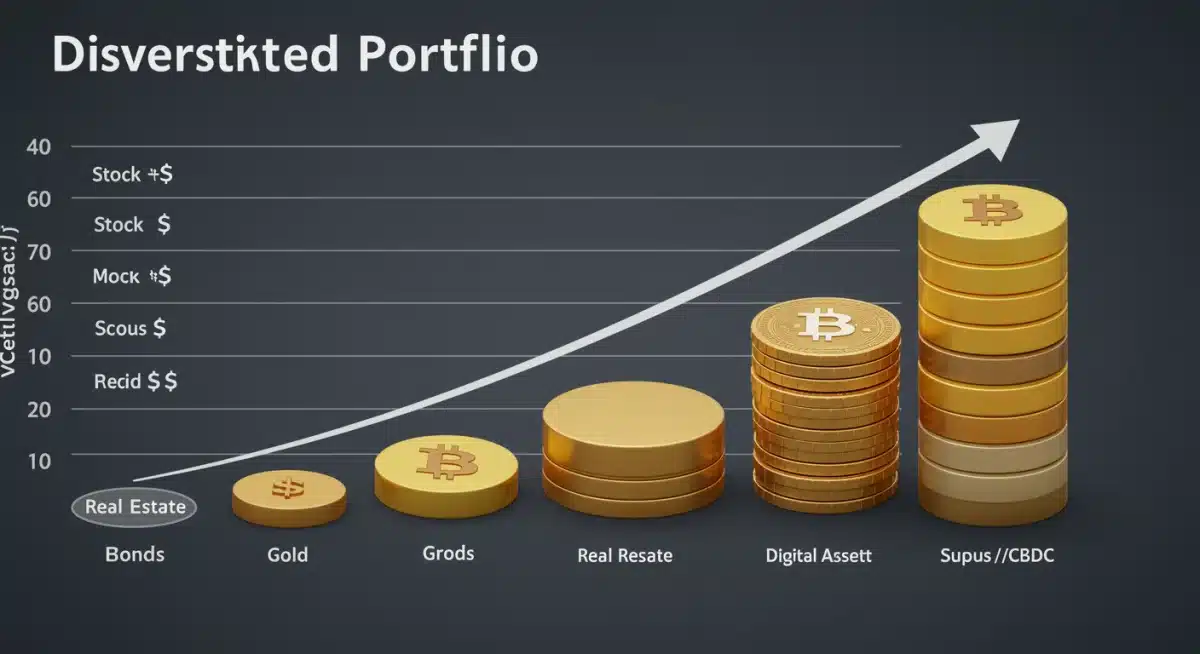
Diversification remains a cornerstone of sound investment strategy, but its application will need to evolve. Traditional diversification across equities, bonds, and commodities should be maintained, but with an added layer of consideration for how each asset class interacts with a CBDC-driven financial system. For instance, assets that offer inflation protection or have low correlation with digital currency fluctuations might become more attractive.
Considering Digital Asset Exposure
Integrating digital assets into a diversified portfolio is becoming less of a niche strategy and more of a mainstream consideration. This doesn’t necessarily mean large allocations, but rather a thoughtful inclusion of assets like Bitcoin, Ethereum, or even well-vetted tokenized securities, commensurate with an investor’s risk tolerance and long-term objectives.
- Risk Management: Understand the unique risks associated with digital assets, including volatility and regulatory uncertainty.
- Small Allocations: Start with small, manageable positions to gain exposure and experience.
- Long-Term Horizon: Approach digital asset investments with a long-term perspective, acknowledging short-term price fluctuations.
Furthermore, investors should pay close attention to companies that are innovating within the digital economy. This includes not only direct blockchain and crypto firms but also traditional companies that are successfully integrating digital currency solutions, leveraging AI, or adapting their business models for a more digital-centric financial future. These ‘digital transformation’ plays could offer significant growth potential.
Ultimately, strategic portfolio allocation in 2026 will involve a blend of traditional prudence and innovative foresight. It means understanding the macro shifts driven by CBDCs, assessing the evolving digital asset landscape, and constructing a portfolio that is resilient, diversified, and poised for growth in a new financial era.
Navigating Risks and Regulatory Landscape for U.S. Investors
For U.S. investors, navigating the risks and understanding the evolving regulatory landscape associated with CBDCs and the broader digital asset space is paramount by 2026. While the promise of innovation is high, so too are the potential pitfalls, ranging from cybersecurity threats to unexpected policy shifts. Informed decision-making hinges on a clear grasp of these factors.
One of the primary risks associated with CBDCs, particularly for retail investors, could be privacy concerns. While central banks emphasize data security, the potential for increased government oversight of transactions is a topic of ongoing debate. Investors must weigh the benefits of a stable digital currency against potential privacy trade-offs. Cybersecurity also remains a critical concern; any large-scale digital currency system becomes an attractive target for malicious actors, necessitating robust protective measures.
Regulatory Clarity and Investor Protection
The regulatory environment for cryptocurrencies and tokenized securities continues to mature. By 2026, the U.S. is expected to have established clearer guidelines regarding their classification, trading, and taxation. This clarity, while potentially imposing stricter compliance, could also bring greater legitimacy and investor protection to the space.
- AML/KYC Compliance: Increased focus on Anti-Money Laundering and Know Your Customer regulations for digital asset platforms.
- Tax Implications: Clearer guidance on how digital asset gains and losses are to be reported and taxed.
- Consumer Protection: Development of frameworks to protect investors from fraud and market manipulation in the digital asset space.
Investors should remain vigilant regarding potential market volatility, especially in the nascent digital asset sector. Geopolitical events, technological breakthroughs, and shifts in global economic sentiment can all have pronounced effects. Moreover, the ‘first-mover’ advantage in CBDC adoption by other nations could influence the U.S. approach, creating a dynamic and sometimes unpredictable policy environment.
In conclusion, successful investing in the CBDC era of 2026 requires more than just identifying opportunities; it demands a proactive approach to risk management and a continuous awareness of regulatory developments. Staying informed and adapting strategies to the evolving landscape will be crucial for protecting and growing capital.
| Key Aspect | Description for U.S. Investors |
|---|---|
| CBDC Definition | Digital form of fiat currency issued by the Federal Reserve, distinct from private cryptocurrencies. |
| Financial System Impact | Potential for payment efficiency, shifts in banking models, and new monetary policy tools. |
| Portfolio Reassessment | Traditional assets influenced by CBDC stability, liquidity, and macroeconomic effects. |
| Digital Asset Integration | Consider measured exposure to cryptocurrencies and tokenized securities for diversification. |
Frequently Asked Questions About CBDCs and Investments
It is highly unlikely that a U.S. CBDC will completely replace physical cash by 2026. The Federal Reserve has indicated that a digital dollar would likely coexist with physical currency, offering an additional payment option rather than a replacement. Cash remains important for financial inclusion and privacy for many citizens.
The impact on your bank account and savings depends on the CBDC’s design. If a retail CBDC allows direct accounts with the Fed, it might offer a risk-free alternative to commercial bank deposits. However, many models propose banks as intermediaries, meaning your savings could remain largely with commercial institutions, albeit with potentially altered dynamics.
A U.S. CBDC is designed as a stable form of digital currency, not an investment asset. It would function like a digital dollar, maintaining its value relative to the U.S. dollar, similar to how cash works. Therefore, direct ‘investment’ in a CBDC for capital appreciation is not its intended purpose.
The influence of CBDCs on cryptocurrencies is a subject of debate. Some believe CBDCs could compete with stablecoins and even act as a more regulated alternative, while others argue they could legitimize the broader digital asset space, providing clearer on-ramps and off-ramps, potentially increasing overall adoption and liquidity.
Key risks for investors include potential shifts in banking profitability, new forms of monetary policy affecting interest rates, cybersecurity vulnerabilities, and evolving regulatory frameworks for digital assets. Understanding these risks and adapting portfolio strategies accordingly will be essential for informed decision-making.
Conclusion
By 2026, the landscape of digital currencies, particularly with the potential introduction of Central Bank Digital Currencies (CBDCs), will undoubtedly reshape the financial future for U.S. investors. While CBDCs offer significant advancements in payment efficiency and monetary policy tools, they also introduce complexities for traditional banking, asset valuations, and regulatory oversight. Strategic portfolio allocation will demand a nuanced understanding of these shifts, balancing traditional diversification with considered exposure to the evolving digital asset ecosystem. Staying informed, adapting to regulatory changes, and maintaining a long-term perspective will be paramount for navigating this transformative era and securing financial success.