Student Loan Repayment 2025: Save Thousands Annually

Effectively navigating student loan repayment options in 2025 is crucial for financial well-being, offering pathways to significantly reduce annual costs and manage debt efficiently through informed choices and strategic planning.
Are you feeling overwhelmed by your student loan debt? You’re not alone. Understanding your options for student loan repayment 2025 is not just about making monthly payments; it’s about strategizing to save thousands annually and achieve financial freedom sooner. This guide is designed to empower you with the knowledge and tools to make informed decisions about your student loans.
Understanding your current loan landscape
Before diving into specific repayment strategies, it’s essential to have a clear picture of your existing student loans. This initial assessment forms the bedrock of any effective repayment plan. Knowing the specifics of your loans—who holds them, their interest rates, and their current status—allows you to identify potential areas for optimization and savings.
Many borrowers have a mix of federal and private loans, each with distinct terms and conditions. Federal loans, for instance, often offer more flexible repayment plans and borrower protections compared to private loans. Taking the time to gather all this information will prevent surprises down the road and ensure you choose the most suitable path.
Federal versus private loans: Key distinctions
- Federal loans: Originated by the U.S. Department of Education, these loans come with various benefits, including income-driven repayment plans, deferment, forbearance, and potential forgiveness programs. Their interest rates are typically fixed.
- Private loans: Issued by banks, credit unions, or other private lenders, these loans generally have fewer borrower protections. Their interest rates can be fixed or variable, often depending on your creditworthiness.
It’s also important to verify the servicer for each of your loans. Your loan servicer is the company that handles your billing and other services. Knowing who your servicer is crucial for asking questions, updating your information, and exploring repayment options. This initial step, though seemingly simple, is often overlooked but vital for effective debt management.
Exploring income-driven repayment (IDR) plans
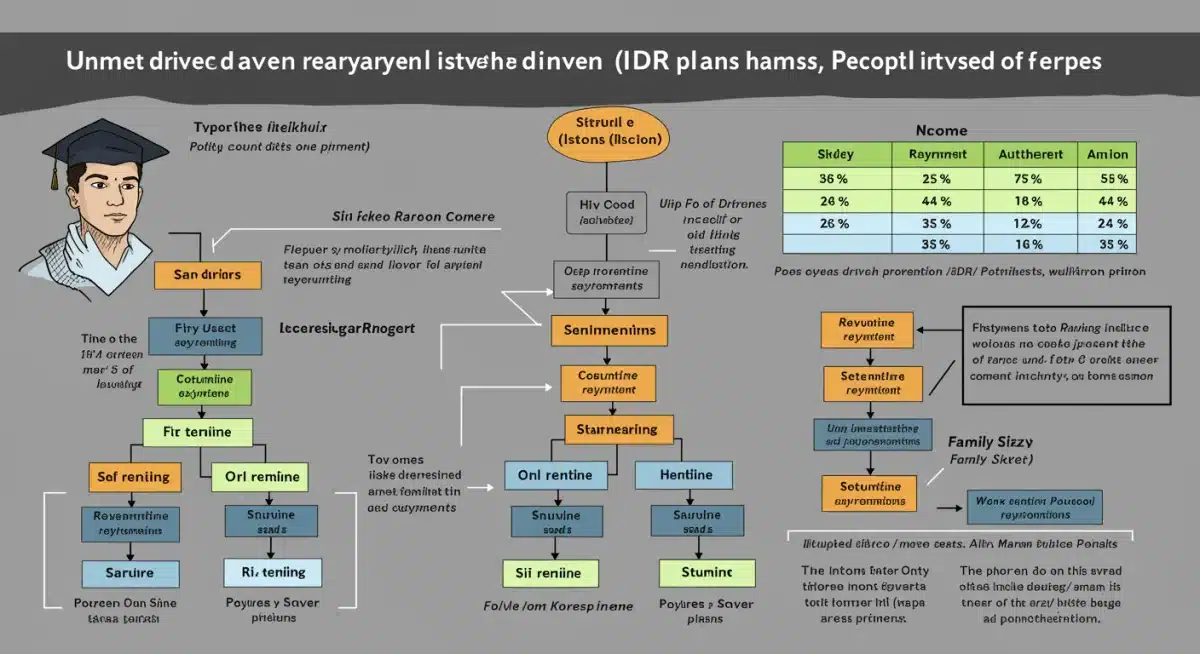
For federal student loan borrowers, income-driven repayment (IDR) plans can be a game-changer, especially for those experiencing financial hardship or with lower incomes relative to their debt. These plans adjust your monthly payment based on your income and family size, potentially reducing your payments to as low as $0 per month. Understanding the nuances of each IDR plan is key to selecting the one that best fits your financial situation.
The core benefit of IDR plans is their ability to provide a safety net, preventing default and offering a path to eventual loan forgiveness after a certain number of qualifying payments. However, the trade-off can be a longer repayment period and, in some cases, a larger total amount paid over the life of the loan due to accrued interest. It’s a balance between affordability now and total cost later.
Types of IDR plans and their benefits
There are several IDR plans available, each with slightly different formulas for calculating payments and varying forgiveness timelines. The most common include:
- SAVE Plan (Saving on a Valuable Education): This new plan, replacing the REPAYE Plan, often offers the lowest monthly payments. It calculates payments based on a smaller portion of discretionary income and has additional benefits, such as preventing unpaid interest from capitalizing if you make your full monthly payment.
- PAYE Plan (Pay As You Earn): Payments are generally 10% of your discretionary income, but never more than what you’d pay under the Standard Repayment Plan. Loans are forgiven after 20 years of payments.
- IBR Plan (Income-Based Repayment): Payments are 10% or 15% of your discretionary income, depending on when you took out your loans. Forgiveness is typically after 20 or 25 years.
- ICR Plan (Income-Contingent Repayment): The oldest IDR plan, payments are the lesser of 20% of your discretionary income or what you’d pay on a fixed 12-year repayment plan, adjusted by income. Forgiveness occurs after 25 years.
Choosing the right IDR plan requires careful consideration of your current income, expected future earnings, family size, and total loan balance. The Department of Education’s loan simulator tool can be incredibly helpful in comparing potential monthly payments and total costs under different plans. Regularly recertifying your income and family size annually is critical to ensure your payments remain accurate and affordable.
Refinancing and consolidation strategies
Refinancing and consolidation are two powerful tools that can significantly alter your student loan repayment trajectory, potentially saving you thousands of dollars over time. While often used interchangeably, they serve distinct purposes and are applicable to different types of loans. Understanding these differences is crucial for making an informed decision about which strategy, if any, is right for you.
Refinancing involves taking out a new loan, typically from a private lender, to pay off one or more existing student loans. The primary goal is often to secure a lower interest rate, which can lead to substantial savings on total interest paid and a reduction in monthly payments. Consolidation, on the other hand, primarily applies to federal student loans and merges multiple federal loans into a single new loan with a weighted average interest rate.
Private loan refinancing: Lowering interest rates
- Eligibility: Generally requires a good credit score, stable income, and a low debt-to-income ratio. A co-signer can often help secure a better rate.
- Benefits: Can significantly lower your interest rate, reduce your monthly payment, and simplify your repayment by having only one loan to manage.
- Considerations: Refinancing federal loans into a private loan means forfeiting federal benefits like IDR plans, deferment, forbearance, and forgiveness programs. This is a crucial trade-off to weigh.
Federal loan consolidation: Simplifying and accessing benefits
Federal Direct Consolidation Loans allow you to combine multiple federal student loans into a single loan with one monthly payment. The interest rate is a weighted average of your original loans, rounded up to the nearest one-eighth of a percentage, so it won’t necessarily lower your interest rate. However, consolidation can open doors to certain federal repayment plans or forgiveness programs that might not have been available to all your individual loans. It simplifies administration and can extend your repayment term, which lowers your monthly payment but may increase total interest paid.
Before pursuing either option, thoroughly research reputable lenders and compare offers. Use online calculators to estimate potential savings and always read the fine print. The decision to refinance or consolidate should align with your long-term financial goals and risk tolerance.
Leveraging student loan forgiveness programs
Student loan forgiveness programs represent a significant opportunity for many borrowers to reduce or eliminate their federal student loan debt. These programs are not universally available and typically require meeting specific eligibility criteria, often tied to public service or certain professions. Staying informed about these options and understanding their requirements can lead to substantial financial relief.
The landscape of forgiveness programs can be complex and subject to change, making it essential to keep abreast of the latest updates from the Department of Education. While private student loans generally do not qualify for federal forgiveness programs, some private lenders may offer their own hardship programs or settlement options under specific circumstances.
Key federal forgiveness programs
- Public Service Loan Forgiveness (PSLF): Designed for borrowers who work full-time for a qualifying government or non-profit organization. After making 120 qualifying monthly payments under a qualifying repayment plan (often an IDR plan), the remaining balance on your Direct Loans is forgiven.
- Teacher Loan Forgiveness: For teachers who work for five complete and consecutive academic years in a low-income school or educational service agency. Depending on the subject taught, up to $17,500 in Direct Subsidized and Unsubsidized Loans can be forgiven.
- Income-Driven Repayment (IDR) Forgiveness: As mentioned earlier, any remaining balance on federal student loans after 20 or 25 years of payments under an IDR plan is forgiven. Be aware that the forgiven amount may be considered taxable income by the IRS, though this rule has varied in the past.
- Total and Permanent Disability (TPD) Discharge: Borrowers who are totally and permanently disabled may be eligible to have their federal student loans discharged. This typically requires documentation from a physician or a determination from the Social Security Administration or Department of Veterans Affairs.
It’s critical to track your eligibility and payments meticulously if you’re pursuing a forgiveness program. For PSLF, for example, using the PSLF Help Tool and submitting an Employment Certification Form annually is highly recommended to ensure your payments are counted correctly. Proactive engagement with your loan servicer and understanding the specific requirements of each program are vital for successful forgiveness.
Budgeting and extra payment strategies
Beyond choosing the right repayment plan, proactive budgeting and making extra payments can dramatically accelerate your debt payoff and save you significant interest. Even small, consistent extra payments can chip away at your principal balance more quickly than you might imagine, especially when applied to high-interest loans. This approach requires discipline and careful financial planning, but the rewards are substantial.
A well-structured budget is the foundation for finding extra funds. By tracking your income and expenses, you can identify areas where you can cut back and reallocate those savings towards your student loans. This isn’t about deprivation, but about making conscious choices that align with your financial goals.
Implementing an effective budget
- Track everything: Use budgeting apps, spreadsheets, or even pen and paper to monitor every dollar in and out.
- Identify non-essentials: Pinpoint areas where you can reduce spending, such as dining out, entertainment, or subscriptions you rarely use.
- Set clear goals: Define how much extra you want to pay each month and how that impacts your payoff timeline.
- Automate savings: Set up automatic transfers from your checking account to a dedicated savings account or directly to your loan servicer for extra payments.
When making extra payments, instruct your loan servicer to apply the additional funds directly to the principal balance of your highest-interest loan. This strategy, often called the ‘debt avalanche’ method, minimizes the total interest you’ll pay over the life of your loans. If you have multiple loans, prioritizing them by interest rate can optimize your savings. Even an extra $50 or $100 per month can make a significant difference over several years, shortening your repayment period and freeing up your finances for other goals.
Staying informed and adapting to changes
The landscape of student loan repayment is not static; it’s subject to policy changes, economic shifts, and new legislative actions. Staying informed about these developments is paramount to effectively managing your debt and seizing new opportunities that may arise. What was true for student loan repayment in 2023 or 2024 might not be fully accurate in 2025 and beyond.
Reliable sources for information include the U.S. Department of Education’s official website, student loan servicer communications, and reputable financial news outlets. Avoid relying solely on social media or unverified sources, as misinformation can lead to poor financial decisions. Proactive engagement with these resources ensures you’re always operating with the most current and accurate information.
Key areas to monitor for updates
- Legislative changes: New laws can introduce new repayment plans, expand existing forgiveness programs, or alter interest rate structures.
- Policy updates: The Department of Education frequently updates its policies regarding deferment, forbearance, and IDR plan administration.
- Economic conditions: Changes in interest rates or inflation can influence refinancing opportunities and the overall cost of borrowing.
- Servicer communications: Always read emails and letters from your loan servicer, as they often contain critical information about your account or available options.
Regularly reviewing your loan details and repayment plan is also a good practice. Your financial situation can change, and a plan that was optimal a few years ago might no longer be the best fit. For example, a significant increase in income might make a standard repayment plan more advantageous than an IDR plan, or vice-versa. Adapting your strategy as your circumstances evolve is key to long-term financial success and maximizing your annual savings.
| Key Strategy | Benefit |
|---|---|
| Understand Loan Types | Distinguish federal vs. private to access appropriate benefits and protections. |
| Utilize IDR Plans | Reduce monthly payments based on income, potentially leading to forgiveness. |
| Consider Refinancing/Consolidation | Lower interest rates (refinance) or simplify payments (consolidation) for savings. |
| Strategic Extra Payments | Accelerate debt payoff and minimize total interest paid by budgeting for extra principal payments. |
Frequently asked questions about student loan repayment
The SAVE Plan (Saving on a Valuable Education) is the newest income-driven repayment plan, offering potentially the lowest monthly payments by calculating them based on a smaller portion of discretionary income. It also prevents interest from capitalizing if you make your full monthly payment, unlike previous plans.
No, if you refinance federal student loans with a private lender, you will forfeit all federal benefits, including access to income-driven repayment plans, deferment, forbearance, and federal loan forgiveness programs. This trade-off should be carefully considered based on your financial situation.
It’s advisable to review your student loan repayment strategy annually, or whenever there’s a significant change in your financial situation, such as a job change, salary increase, or change in family size. This ensures your plan remains optimal for your current circumstances.
PSLF is a federal program that forgives the remaining balance on Direct Loans for borrowers who work full-time for a qualifying government or non-profit organization and have made 120 qualifying monthly payments under a qualifying repayment plan.
Historically, forgiven amounts under IDR plans were considered taxable income. However, specific legislative actions, like the American Rescue Plan, have temporarily made certain forgiven amounts tax-free. It’s crucial to consult a tax professional for the most current information regarding your specific situation in 2025.
Conclusion
Navigating student loan repayment in 2025 requires a proactive, informed, and adaptable approach. By understanding your loan types, exploring income-driven options, considering refinancing or consolidation, leveraging forgiveness programs, and implementing smart budgeting with extra payments, you can significantly reduce your financial burden. Staying informed about policy changes and regularly reviewing your strategy will ensure you’re always on the most advantageous path, ultimately saving you thousands annually and paving the way to greater financial stability.