2026 Social Security COLA: What a 3.2% Increase Means for Your Benefits

Navigating the 2026 Social Security COLA: What a 3.2% Increase Means for Your Monthly Benefits
For millions of Americans, Social Security benefits represent a vital lifeline, providing essential income during retirement, disability, or survivorship. Each year, beneficiaries eagerly await the announcement of the Cost-of-Living Adjustment (COLA), a crucial mechanism designed to help benefits keep pace with inflation. As we look towards 2026, projections suggest a 2026 Social Security COLA of approximately 3.2%. While this is still a projection and not a final figure, understanding its potential impact is essential for effective financial planning.
This comprehensive guide will delve deep into what a 3.2% COLA could mean for your monthly Social Security checks. We’ll explore the intricate process of how COLA is calculated, examine historical trends, and discuss strategies to maximize your benefits in an ever-changing economic landscape. Whether you are a current recipient, nearing retirement, or simply planning for the future, grasping the nuances of the 2026 Social Security COLA is paramount.
Understanding the Social Security COLA: The Basics
Before we dive into the specifics of the projected 3.2% increase for 2026, let’s establish a foundational understanding of what the Social Security COLA is and why it matters.
What is the COLA?
COLA stands for Cost-of-Living Adjustment. It’s an annual increase in Social Security and Supplemental Security Income (SSI) benefits to offset the effects of inflation. The idea is to ensure that the purchasing power of beneficiaries’ payments doesn’t erode over time due to rising prices of goods and services. Without COLA, a fixed benefit amount would buy less and less each year, making it increasingly difficult for retirees and other beneficiaries to maintain their standard of living.
How is COLA Calculated?
The Social Security Administration (SSA) determines the COLA based on the Consumer Price Index for Urban Wage Earners and Clerical Workers (CPI-W). Specifically, the SSA compares the average CPI-W for the third quarter (July, August, and September) of the current year with the average for the third quarter of the last year in which a COLA was enacted. The percentage increase between these two averages determines the COLA for the upcoming year. If there is no increase, or if prices decrease, there is no COLA. This is why some years have seen a 0% COLA.
It’s important to note that the CPI-W measures a specific basket of goods and services consumed by urban wage earners and clerical workers. Critics often argue that this index doesn’t accurately reflect the spending patterns of seniors, who typically spend more on healthcare and housing than younger workers. However, for now, the CPI-W remains the official metric for COLA calculations.
When is the COLA Announced and Effective?
The official COLA announcement typically occurs in October, after the September CPI-W data becomes available. Once announced, the new COLA takes effect in December of the current year, meaning beneficiaries will see the adjusted amount in their January checks of the following year. For the 2026 Social Security COLA, the official announcement would be in October 2025, with the increase reflected in checks starting January 2026.
The Projected 3.2% 2026 Social Security COLA: What It Means
A projected 3.2% COLA for 2026, while not as high as some recent years, still represents a significant boost for beneficiaries. Let’s break down what this could mean in practical terms.
Impact on Your Monthly Benefits
To understand the direct impact, simply multiply your current monthly benefit by 3.2%. For example:
- If your current monthly benefit is $1,500, a 3.2% COLA would add $48 to your check, bringing it to $1,548.
- For a benefit of $2,000, the increase would be $64, resulting in $2,064 per month.
- If you receive the estimated average retirement benefit (which is currently around $1,907 for 2024), a 3.2% increase would add approximately $61.02, bringing your monthly benefit to around $1,968.02.
These increases, while seemingly modest on a monthly basis, accumulate over the year, providing a substantial boost to annual income. Over the course of a year, an extra $48 per month translates to an additional $576, which can make a noticeable difference in covering rising costs.
Why 3.2%? The Economic Factors at Play
The 2026 Social Security COLA is rooted in current economic forecasts and inflation trends. Several factors influence these projections:
- Inflationary Environment: The primary driver of COLA is inflation. The CPI-W data for the relevant months will largely dictate the final COLA percentage. Current projections suggest that while inflation may be cooling from its recent peaks, it is still expected to remain elevated enough to warrant a significant adjustment.
- Energy Prices: Fluctuations in oil and gas prices have a substantial impact on the CPI-W, as transportation costs are a major component. Stable or slightly increasing energy prices can contribute to a higher COLA.
- Food Costs: Food inflation also plays a critical role. When grocery prices rise, the CPI-W tends to follow suit.
- Housing Expenses: Rent and housing costs are another significant factor. Persistent increases in housing expenses can push the CPI-W upwards, contributing to a higher COLA.
It’s critical to remember that these are projections. The actual COLA for 2026 will depend on the CPI-W data released in the summer and early fall of 2025. Unforeseen economic shifts could alter this projection.
Historical Context: COLA Trends and Their Significance
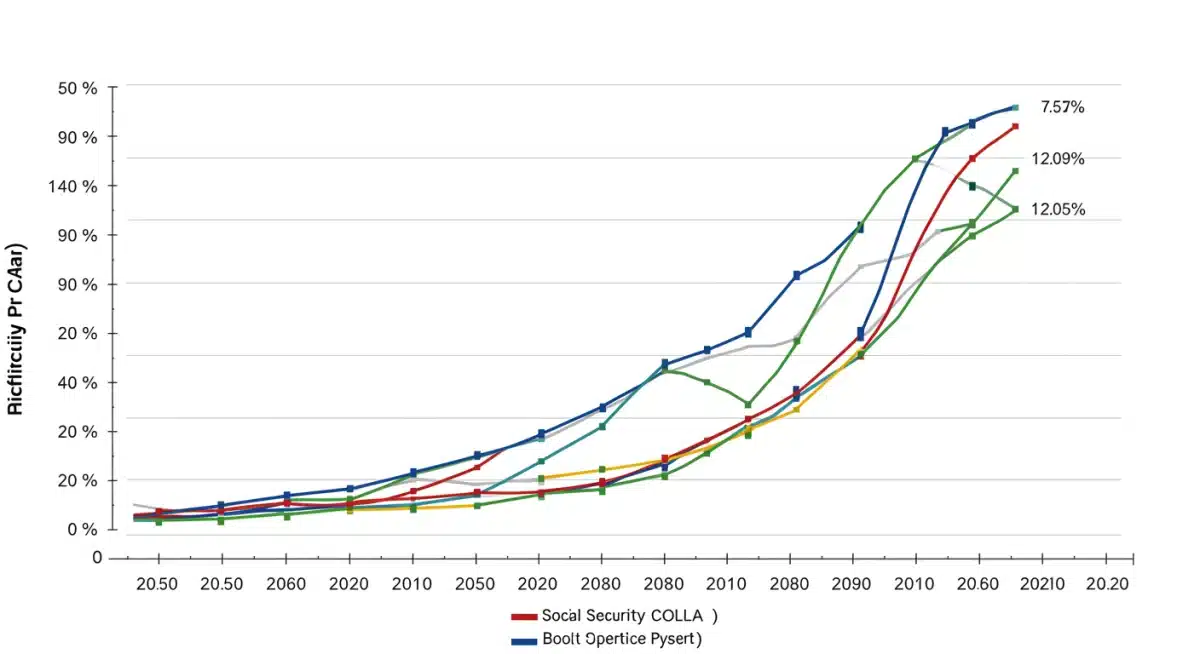
Understanding the historical trajectory of COLA adjustments provides valuable context for the projected 2026 Social Security COLA.
A Look Back at Recent COLA Adjustments
Over the past few decades, COLA adjustments have varied significantly, reflecting the economic climate:
- High COLA Years: We’ve seen periods with very high COLAs, such as 2022 (5.9%), 2023 (8.7%), and 2024 (3.2%), driven by surges in inflation. These larger increases were a direct response to the rapid rise in consumer prices experienced in the preceding years.
- Low or Zero COLA Years: Conversely, there have been years with very low or even zero COLA. For example, in 2010, 2011, and 2016, the COLA was 0% due to low or negative inflation rates following economic downturns.
The projected 3.2% for 2026 sits comfortably in the middle range, suggesting a continued effort to keep pace with persistent, albeit moderating, inflation.
The Purpose of COLA: Maintaining Purchasing Power
The primary purpose of COLA is to maintain the purchasing power of Social Security benefits. Imagine if your retirement income remained fixed while the cost of groceries, utilities, and medical care steadily increased. Over time, your fixed income would buy less and less, severely impacting your quality of life. COLA aims to prevent this erosion, ensuring that beneficiaries can afford essential goods and services.
However, it’s also important to acknowledge that COLA doesn’t always fully cover the specific cost increases faced by seniors. As mentioned earlier, the CPI-W might not perfectly align with the spending habits of older adults, particularly concerning healthcare costs, which tend to rise faster than general inflation. This disparity is a continuous point of discussion and advocacy among senior groups.
Beyond the Percentage: Other Factors Affecting Your Social Security Benefits
While the 2026 Social Security COLA is a significant factor, it’s not the only element that can influence your net benefit amount.
Medicare Part B Premiums
One of the most impactful factors for many beneficiaries is the deduction for Medicare Part B premiums. These premiums are often deducted directly from Social Security checks. If Part B premiums increase at a faster rate than the COLA, the net increase in your Social Security check might be smaller than expected, or in some cases, your net benefit could even decrease.
The ‘hold harmless’ provision is crucial here: it prevents most Social Security beneficiaries from seeing a reduction in their net Social Security payment due to an increase in their Medicare Part B premium. This provision ensures that your Part B premium increase will not cause your monthly Social Security benefit to be lower than it was in the previous year. However, this only applies if your Part B premiums are deducted directly from your Social Security benefits and your income is below a certain threshold. High-income earners may not be protected by this provision.
Income Taxation of Benefits
Depending on your total income, a portion of your Social Security benefits may be subject to federal income tax. The thresholds for taxation are:
- Up to 50% of your benefits may be taxable if your ‘combined income’ is between $25,000 and $34,000 for an individual, or between $32,000 and $44,000 for a married couple filing jointly.
- Up to 85% of your benefits may be taxable if your combined income is above $34,000 for an individual, or above $44,000 for a married couple filing jointly.
A higher COLA means a higher gross benefit, which could potentially push some individuals or couples into a higher tax bracket or increase the taxable portion of their benefits. It’s essential to factor this into your overall financial planning.
Working While Receiving Benefits
If you are receiving Social Security benefits and continue to work, your earnings may reduce your benefit amount if you are below your full retirement age. The SSA has annual earnings limits. If your earnings exceed these limits, a portion of your benefits will be withheld. These earnings limits are also subject to annual adjustments, often tied to wage inflation. A COLA increase does not change these limits directly, but it’s another factor to consider if you are combining work with benefits.
Maximizing Your Social Security Benefits: Strategies and Tips
Understanding the 2026 Social Security COLA is just one piece of the puzzle. Proactive planning can help you maximize your Social Security income throughout your retirement.
1. Understand Your Full Retirement Age (FRA)
Your Full Retirement Age (FRA) is the age at which you are entitled to receive 100% of your primary insurance amount (PIA). This age varies based on your birth year. Claiming benefits before your FRA results in a permanent reduction, while delaying benefits past your FRA (up to age 70) results in delayed retirement credits, increasing your monthly payment.
2. Consider Delaying Benefits
For every year you delay claiming Social Security benefits past your FRA, up to age 70, your benefit amount increases by a certain percentage (currently 8% per year). This is a guaranteed return that is hard to beat elsewhere. A higher initial benefit means that future COLAs, including the 2026 Social Security COLA, will be applied to a larger base amount, resulting in a larger dollar increase. This strategy is particularly powerful for those who can afford to wait.
3. Work at Least 35 Years
Your Social Security benefit is calculated based on your 35 highest-earning years. If you have fewer than 35 years of earnings, the SSA will fill in the missing years with zeros, which can significantly lower your average indexed monthly earnings (AIME) and, consequently, your benefit. Working for at least 35 years, and ideally during your peak earning years, can substantially boost your ultimate benefit.
4. Review Your Social Security Statement Annually
It’s crucial to review your Social Security statement annually. You can access it online through your "my Social Security" account. This statement provides an estimate of your future benefits, details your earnings history, and allows you to check for any inaccuracies. Correcting errors in your earnings record can ensure you receive all the benefits you’re entitled to.
5. Coordinate with Your Spouse
For married couples, there are various strategies to maximize combined Social Security benefits. These often involve one spouse delaying benefits to build up a larger payment, while the other claims spousal benefits or their own lower benefit. Understanding survivor benefits is also critical for long-term financial security. Consulting with a financial advisor specializing in Social Security can help couples navigate these complex decisions.
6. Plan for Medicare Premiums
As discussed, Medicare Part B premiums can significantly impact your net Social Security benefit. Factor these costs into your retirement budget. For higher-income earners, be aware of the Income-Related Monthly Adjustment Amount (IRMAA), which can lead to higher Part B and Part D premiums. Strategic income planning in retirement can sometimes help mitigate IRMAA.

The Broader Economic Picture and the 2026 Social Security COLA
The 2026 Social Security COLA doesn’t exist in a vacuum; it’s a reflection of the broader economic environment and has wider implications.
Inflation and Its Impact on Retirees
While COLA aims to protect against inflation, it’s essential to understand that inflation itself disproportionately affects certain segments of the population, including retirees. Seniors often rely on fixed incomes and may have less flexibility to increase their earnings. Rising costs for essentials like food, housing, and healthcare can quickly erode savings if not adequately addressed by COLA and other retirement income sources. The 3.2% COLA for 2026 suggests that inflation is still a concern, even if it’s not at the peak levels seen recently.
Sustainability of Social Security
Frequent and substantial COLA increases, while beneficial for beneficiaries, also place greater demands on the Social Security trust funds. The long-term solvency of Social Security is an ongoing debate. While the trust funds are currently projected to be able to pay 100% of promised benefits until the mid-2030s, after which they would be able to pay about 80%, higher COLAs can accelerate the depletion of these funds. This makes the discussion around COLA not just about individual benefits but also about the program’s overall financial health.
Political and Policy Considerations
The method of calculating COLA is a frequent topic of debate in Washington. Some advocate for switching to the Consumer Price Index for the Elderly (CPI-E), which is specifically designed to reflect the spending patterns of older Americans and typically shows higher inflation rates due to the heavier weighting of healthcare costs. A switch to CPI-E would likely result in higher COLAs, offering greater financial relief to seniors but also increasing the strain on the Social Security system. The projected 2026 Social Security COLA is based on the current CPI-W methodology, but these policy discussions continue in the background.
Preparing for the Future: What to Do Now
Even though the 2026 Social Security COLA is still a projection, taking proactive steps now can help you better prepare for its eventual impact and your overall financial future.
1. Stay Informed
Keep an eye on economic news, particularly inflation reports and CPI-W data. While the official COLA announcement for 2026 won’t come until October 2025, early indicators can provide a good sense of what to expect. Follow reliable financial news sources and the official Social Security Administration website for updates.
2. Re-evaluate Your Budget
Regularly review and adjust your retirement budget. Account for rising costs in areas like healthcare, food, and utilities. Even with a COLA, these expenses might outpace your benefit increase, requiring adjustments elsewhere in your spending. Understanding where your money goes is the first step to effective financial management.
3. Consult a Financial Advisor
A qualified financial advisor can provide personalized guidance on how the 2026 Social Security COLA and other factors will affect your specific financial situation. They can help you develop a comprehensive retirement plan that integrates your Social Security benefits with other income sources, investments, and savings, ensuring you have a robust strategy for long-term financial security. They can also assist with tax planning related to your benefits and other retirement income.
4. Explore Other Income Streams
While Social Security is a cornerstone of retirement income for many, it’s rarely sufficient on its own. Explore other income streams such as:
- Personal Savings and Investments: IRAs, 401(k)s, and other investment vehicles can provide a substantial boost to your retirement income.
- Part-Time Work: Many retirees choose to work part-time, not just for the income but also for social engagement and mental stimulation.
- Annuities: These can provide a guaranteed income stream for life, supplementing your Social Security benefits.
Diversifying your income sources provides a stronger financial safety net and makes you less reliant on any single source, including Social Security.
Conclusion: A Crucial Adjustment for Retirees
The projected 3.2% 2026 Social Security COLA is a significant development that will directly impact the financial well-being of millions of Americans. While it’s still a projection, understanding its potential implications, how it’s calculated, and its historical context is vital for effective retirement planning.
This adjustment underscores the ongoing challenge of inflation and the importance of Social Security in maintaining the purchasing power of beneficiaries. By staying informed, proactively managing your finances, and seeking professional advice, you can navigate these changes successfully and ensure a more secure and comfortable retirement. Remember, Social Security is a dynamic system, and staying engaged with its updates and understanding how they affect you is a continuous process. Your financial future depends on it.