Navigating 2026 FAFSA Changes: Your Essential Guide to College Aid

Navigating the 2026 FAFSA Changes: Your Essential Guide to College Aid
The landscape of college financial aid is continuously evolving, and for prospective students and their families, staying informed about these shifts is paramount. As we look ahead to the 2026-2027 academic year, significant revisions to the Free Application for Federal Student Aid (FAFSA) are set to reshape how students apply for and receive federal financial assistance. These 2026 FAFSA Changes are designed to simplify the application process, expand eligibility for federal aid, and provide a more equitable distribution of funds. Understanding these updates now can give you a substantial advantage in planning for your higher education journey.
The FAFSA is the gateway to billions of dollars in federal grants, scholarships, work-study programs, and federal student loans. Its importance cannot be overstated. However, for many, the application has historically been perceived as complex and daunting. The upcoming changes aim to alleviate some of these challenges, but they also introduce new terminology and methodologies that require careful attention. This comprehensive guide will walk you through the most critical 2026 FAFSA Changes, offering insights and actionable advice to help you navigate this new terrain successfully.
From the introduction of the Student Aid Index (SAI) to the expanded use of federal tax information, each modification has implications for your financial aid package. Our goal is to demystify these changes, ensuring you are well-prepared to maximize your opportunities for financial assistance. Whether you are a high school student dreaming of college, a parent planning for your child’s future, or an adult learner returning to academia, these 2026 FAFSA Changes will affect you. Let’s delve into the specifics and equip you with the knowledge you need.
Understanding the Core Philosophy Behind the 2026 FAFSA Changes
The overarching goal of the FAFSA Simplification Act, which underpins the 2026 FAFSA Changes, is to make federal student aid more accessible and understandable for all students. For years, the FAFSA has been criticized for its length, complexity, and sometimes confusing terminology. These criticisms have often led to eligible students missing out on aid simply because they were intimidated by the application process or misunderstood its requirements. The new legislation seeks to rectify these issues, fostering a more inclusive and efficient system.
One of the primary drivers behind these reforms is the desire to expand Pell Grant eligibility. Pell Grants are a cornerstone of federal financial aid, providing need-based grants to low-income undergraduate students. By streamlining the FAFSA and adjusting the eligibility criteria, more students from diverse socioeconomic backgrounds are expected to qualify for this vital assistance. This expansion is not just about increasing the number of recipients but also about ensuring that those who need aid the most receive a more substantial amount.
Furthermore, the 2026 FAFSA Changes aim to reduce administrative burden for both applicants and financial aid administrators. A simplified application means less time spent filling out forms for students and less time processing them for institutions. This efficiency can lead to faster aid determinations and a smoother overall experience for everyone involved in the financial aid process. It’s a win-win situation designed to remove barriers and facilitate educational attainment.
Key Update 1: The Shift from EFC to Student Aid Index (SAI)
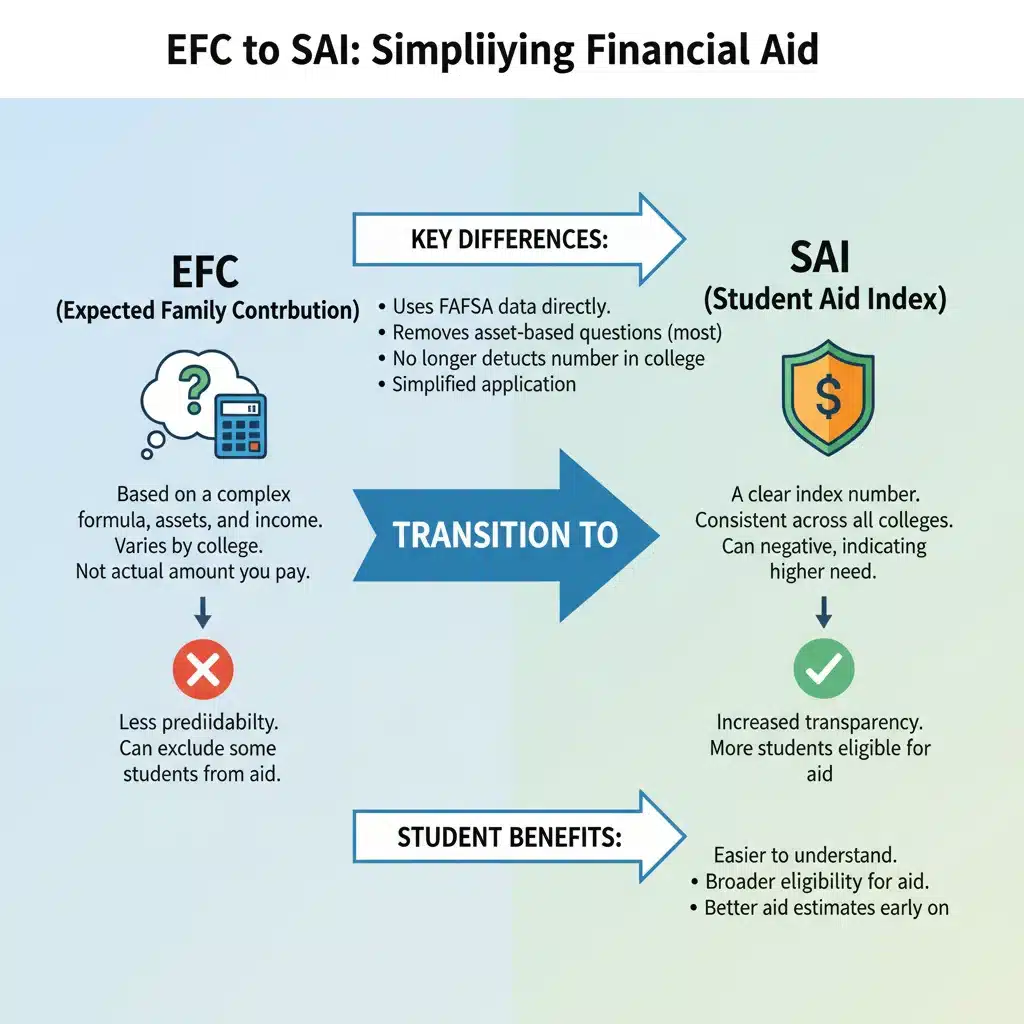
Perhaps the most significant of the 2026 FAFSA Changes is the replacement of the Expected Family Contribution (EFC) with the Student Aid Index (SAI). The EFC has long been a source of confusion for families, as it often didn’t reflect the actual amount a family could realistically pay for college. The name itself was misleading, as it wasn’t a bill but rather an index used to determine aid eligibility.
The new Student Aid Index (SAI) is designed to be a clearer indicator of a student’s eligibility for federal and institutional need-based aid. Unlike the EFC, the SAI can be a negative number, ranging from -1500 to 999,999. A negative SAI indicates a higher level of financial need, potentially allowing students to receive more grant aid. This change is particularly beneficial for students with significant financial challenges, as it more accurately reflects their inability to contribute to college costs.
The calculation of the SAI is also undergoing revisions. While it still considers income and assets, some components will be weighted differently, and certain items will be excluded. For instance, the number of family members in college will no longer be a factor in the SAI calculation, which is a notable departure from the EFC methodology. This specific change could have a significant impact on families with multiple children concurrently enrolled in higher education, potentially reducing the aid they receive compared to previous years. However, other adjustments in the SAI calculation aim to compensate for this, especially for low-income families.
Understanding your SAI will be crucial for estimating your financial aid eligibility. It’s important to remember that a lower SAI generally translates to more financial aid. Familiarizing yourself with the factors that influence the SAI will enable you to better plan and understand your potential aid package. The goal of the SAI is to provide a more transparent and equitable assessment of a student’s financial need, aligning aid distribution more closely with actual financial circumstances.
Key Update 2: Streamlined Application Process and Reduced Questions
One of the most welcomed 2026 FAFSA Changes is the significant simplification of the application itself. The current FAFSA is notoriously long, with over 100 questions that can be overwhelming for first-time applicants. The new FAFSA is expected to reduce the number of questions substantially, making it quicker and easier to complete.
This reduction in questions is largely due to the expanded use of direct data exchange with the IRS. Instead of manually entering tax information, applicants will now provide consent for the Department of Education to directly retrieve their federal tax information (FTI) from the IRS. This not only saves time but also reduces the likelihood of errors, leading to a more accurate and efficient application process. This direct data exchange is mandatory for all applicants and contributors (parents or spouses), and failure to provide consent will result in an invalid FAFSA and ineligibility for federal student aid.
The simplified application will also feature a more intuitive user interface, making it easier to navigate and understand. The aim is to create a FAFSA experience that is less intimidating and more accessible, encouraging more students to apply for the aid they deserve. This simplification is particularly beneficial for students from families who may not have prior experience with the college application process, as it removes a significant barrier to entry.
Key Update 3: Expanded Pell Grant Eligibility and Maximum Awards
As mentioned earlier, a core component of the 2026 FAFSA Changes is the expansion of Pell Grant eligibility. The FAFSA Simplification Act introduces new criteria that will allow more students to qualify for Pell Grants, and in some cases, receive larger awards.
Under the new system, students whose parent or guardian died in the line of duty while serving in the U.S. armed forces or as a public safety officer will be eligible for a maximum Pell Grant. Furthermore, incarcerated students in federal or state penal institutions will regain eligibility for Pell Grants, a significant reversal from previous restrictions. This change aims to support educational opportunities for a population that has historically faced significant barriers to higher education.
The methodology for determining Pell Grant eligibility is also being modified. Some applicants will automatically qualify for a maximum Pell Grant based on their adjusted gross income (AGI) relative to the federal poverty level. Other applicants will receive a minimum Pell Grant based on similar income thresholds. This tiered approach is designed to ensure that the students with the greatest financial need receive the most substantial support, while also providing a baseline level of assistance to other eligible students. These changes reflect a commitment to making higher education more affordable and accessible for all.
Key Update 4: Changes to Family Definition and Contributor Information
The 2026 FAFSA Changes also introduce new terminology and definitions related to family structure and who is considered a ‘contributor’ to the FAFSA. This is a crucial aspect to understand, as it directly impacts whose financial information needs to be reported on the application.
A ‘contributor’ is defined as anyone who is required to provide information on the FAFSA, sign the application, and provide consent for their federal tax information to be shared. This typically includes the student, the student’s parents (if dependent), and the student’s spouse (if applicable). The new FAFSA will require all contributors to have an FSA ID, which is a username and password used to access federal student aid websites. This ensures secure access and consent for data retrieval.
For dependent students, the definition of parent will largely remain consistent, focusing on the parent(s) with whom the student lives most of the time. In cases of divorced or separated parents, the parent who provides the most financial support will be the one whose information is reported, rather than the parent with whom the student lives most of the time, as was previously the case for EFC calculations. This is a significant change that could impact the SAI for many families. It is essential for families to understand this distinction to avoid errors and ensure accurate aid calculations.
The FAFSA Simplification Act also removes the question about the number of family members attending college from the SAI calculation. While this information will still be collected on the FAFSA for informational purposes, it will no longer directly affect a student’s eligibility for federal aid. This change might disproportionately affect middle-income families with multiple children in college, potentially leading to a higher SAI than they would have had under the old system. However, the overall aim is to create a more consistent and predictable calculation for all.
Key Update 5: Impact on Special Circumstances and Professional Judgment
Life is unpredictable, and financial circumstances can change rapidly. The 2026 FAFSA Changes acknowledge this by reinforcing the importance of ‘professional judgment’ – the ability of financial aid administrators to adjust a student’s financial aid package due to special or unusual circumstances. This ensures that the FAFSA remains flexible enough to address individual student needs outside of the standard calculation.
Special circumstances refer to financial situations that justify an aid administrator adjusting data elements used to calculate a student’s SAI. Examples include loss of employment, divorce, death of a parent, or unusually high medical expenses. Unusual circumstances, on the other hand, pertain to conditions that justify an aid administrator making an independent student determination for a student who would otherwise be considered dependent (e.g., homelessness, abuse, or human trafficking).
The FAFSA Simplification Act encourages financial aid offices to use professional judgment more frequently and provides clearer guidelines for doing so. This is a positive development, as it empowers aid administrators to provide more tailored support to students facing hardship. If you experience a significant change in your financial situation after submitting your FAFSA, it is crucial to contact your college’s financial aid office to discuss your options. They can review your situation and potentially adjust your SAI, leading to a more favorable aid package.

Key Update 6: New Rules for Assets and Small Business Exclusion
The way assets are reported and considered in the financial aid calculation is also undergoing revisions as part of the 2026 FAFSA Changes. Historically, certain assets, such as small family farms or businesses, could significantly impact a student’s EFC, even if those assets did not generate substantial liquid income.
Under the new FAFSA, specific assets will be treated differently to provide a more accurate picture of a family’s ability to pay. For example, the net worth of small businesses and family farms that the family lives on and operates will no longer be included in the SAI calculation. This is a significant relief for many families who own and operate these types of assets, as it prevents them from being penalized for non-liquid wealth that is essential to their livelihood.
Furthermore, the FAFSA Simplification Act aims to simplify the reporting of other assets. While the specifics of asset protection allowances and thresholds are subject to further guidance, the general trend is towards a more equitable assessment of family resources. It’s important for families to understand which assets are included and excluded from the SAI calculation to accurately report their financial situation. Consulting with a financial aid advisor or using reliable FAFSA resources can help clarify these nuances.
Key Update 7: Changes to Cost of Attendance (COA) Components
The Cost of Attendance (COA) is a critical figure determined by each college, representing the total estimated expenses for a student to attend that institution for an academic year. It includes tuition and fees, room and board, books and supplies, transportation, and personal expenses. The 2026 FAFSA Changes also bring modifications to how the COA is constructed and utilized in financial aid calculations.
While the fundamental components of COA remain, the new legislation provides clearer definitions and requirements for institutions when calculating and reporting these costs. This aims to create more consistency across institutions and ensure that the COA accurately reflects the true cost of attendance for students. A standardized COA allows for a more transparent comparison of costs between different colleges, aiding students in making informed decisions.
Additionally, the FAFSA Simplification Act emphasizes the importance of institutions clearly communicating their COA to students. This transparency is crucial for students and families to understand the full financial commitment required for higher education and to plan accordingly. A well-defined COA, combined with a clear SAI, will provide a more comprehensive picture of a student’s financial need and the aid they are eligible to receive.
Preparing for the 2026 FAFSA Changes: Actionable Steps
Navigating the 2026 FAFSA Changes might seem complex, but proactive preparation can make a significant difference. Here are some actionable steps you can take to ensure a smooth application process and maximize your financial aid opportunities:
- Create an FSA ID (if you don’t have one): Every student and ‘contributor’ (parent or spouse) will need an FSA ID. This is your digital signature and gateway to federal student aid. Create yours well in advance of applying.
- Gather Your Financial Documents: Even with direct data exchange, it’s wise to have your tax returns, W-2 forms, and records of untaxed income readily available. This will help you verify information and answer any remaining questions accurately.
- Understand the SAI: Familiarize yourself with the new Student Aid Index. Use online calculators (once available and updated for the new methodology) to get an estimated SAI. This will give you a ballpark idea of your financial need.
- Communicate with Your Financial Aid Office: If you have special or unusual circumstances, don’t hesitate to reach out to the financial aid office at your prospective colleges. They are there to help and can use professional judgment to adjust your aid package.
- Stay Informed: The Department of Education will continue to release guidance and resources regarding the 2026 FAFSA Changes. Regularly check official websites and reputable financial aid blogs for updates.
- Complete the FAFSA Early: While the application window typically opens in October, submitting your FAFSA as early as possible is always recommended. Some aid is awarded on a first-come, first-served basis.
- Consider All Aid Types: Remember that FAFSA is not just for federal aid. Many states and colleges use FAFSA data to award their own grants and scholarships. Explore all avenues of financial assistance.
- Review Your Student Aid Report (SAR): After submitting your FAFSA, you’ll receive a Student Aid Report. Review it carefully for any errors and make corrections promptly.
The Long-Term Impact of the 2026 FAFSA Changes
The 2026 FAFSA Changes represent more than just a procedural overhaul; they signify a fundamental shift in the approach to federal student aid. The emphasis on simplification, expanded eligibility, and a more equitable assessment of financial need is expected to have a profound and positive long-term impact on higher education access and affordability.
By making the application process less intimidating, more students who previously might have been discouraged are likely to apply. This could lead to a more diverse student body in colleges and universities across the country. The expanded Pell Grant eligibility, in particular, has the potential to lift financial barriers for countless low-income students, enabling them to pursue their educational aspirations without the burden of excessive debt.
Moreover, the increased transparency and consistency in financial aid calculations will empower families to make more informed decisions about college. Understanding the true cost of attendance and their potential aid eligibility from the outset allows for better financial planning and reduces the likelihood of unexpected financial strain during college years. The focus on professional judgment also ensures that the system remains responsive to individual circumstances, preventing rigid rules from hindering deserving students.
While any major systemic change comes with its own set of adjustments and learning curves, the vision behind the 2026 FAFSA Changes is clear: to create a more student-centered, accessible, and fair financial aid system. As these changes roll out, continuous education and adaptation will be key for students, families, and educational institutions alike.
Conclusion: Embracing the Future of Financial Aid
The upcoming 2026 FAFSA Changes mark a pivotal moment in the evolution of college financial aid in the United States. From the introduction of the Student Aid Index (SAI) to a significantly streamlined application process, these updates are designed to make higher education more attainable and affordable for a broader range of students. While the transition may require some adjustment, the long-term benefits of greater accessibility, transparency, and equity are substantial.
By staying informed, actively preparing, and utilizing the resources available, you can confidently navigate these changes. Remember to create your FSA ID, gather your documents, understand the new SAI, and communicate proactively with financial aid offices. The goal is to demystify the process and empower you to secure the financial assistance you need to achieve your academic dreams.
Embrace these new developments not as challenges, but as opportunities. The reformed FAFSA is a tool designed to unlock educational possibilities, and with the right knowledge and preparation, you can leverage it to your full advantage. Your journey to college is an exciting one, and understanding the 2026 FAFSA Changes is a crucial step in making that journey a reality.